Last updated: July 2026
What do AI search engines actually cite? Based on 2.1 million sources extracted from real ChatGPT, Google AI Mode, and Perplexity answers: mostly brand-owned corporate pages (60.6% of all citations), with Reddit as the single most-cited domain by a factor of 3x, and 73.5% of citations coming from domains outside the top 100. The full findings, and what they mean for your brand, are below.
Key stats:
| Metric | Value |
|---|---|
| Sources Analyzed | 2.1M |
| Unique Domains | 567K |
| Projects Tracked | 1,280 |
| Study Period | 5 months (Nov 2025 - Apr 2026) |
Methodology
Geonimo monitors AI search visibility for brands by sending prompts to ChatGPT, Google AI Mode, and Perplexity daily. Every response is parsed to extract the sources these models cite: the URLs, domains, page titles, and snippets they reference when answering user questions.
This study covers 2.1 million source citations extracted from AI responses between November 2025 and April 2026, across 1,280 active projects spanning industries from e-commerce and SaaS to finance, health, and real estate. Every data point is a URL an engine actually returned in an answer to a real-world prompt: no panel data, no clickstream estimates, no inferred citations.
Finding #1: Corporate Pages Dominate AI Citations (60.6%)
The single largest category of sources cited by AI search engines is Corporate content: company websites, product pages, SaaS documentation, and brand-owned content. It accounts for 60.6% of all citations.
Source Type Distribution (2.1M sources)
| Source Type | Citations | Share |
|---|---|---|
| Corporate | 1,278,980 | 60.6% |
| Editorial | 295,550 | 14.0% |
| UGC (User-Generated Content) | 271,560 | 12.9% |
| Institutional | 203,970 | 9.7% |
| Reference | 57,690 | 2.7% |
This is the most important finding in the dataset. AI search engines overwhelmingly cite brand-owned content. If your company website has well-structured, authoritative pages about what you do, AI models will surface them. This isn't a game dominated by media outlets or Wikipedia: it's dominated by the companies themselves.
Editorial content (news sites, tech publications, industry blogs) comes second at 14%, followed closely by user-generated content at 12.9%. The UGC number is driven almost entirely by Reddit and YouTube, which we'll cover next.
Finding #2: Reddit Is the #1 Cited Domain by a Massive Margin
Across all 2.1 million sources, Reddit is cited more than any other single domain: by a factor of 3x over the runner-up.
Top 15 Most Cited Domains
| Domain | Citations |
|---|---|
| reddit.com | 180,460 |
| youtube.com | 59,880 |
| en.wikipedia.org | 49,930 |
| fr.wikipedia.org | 20,790 |
| arxiv.org | 12,330 |
| linkedin.com | 11,170 |
| shopify.com | 9,450 |
| quora.com | 6,560 |
| lemonde.fr | 5,780 |
| facebook.com | 4,690 |
| medium.com | 4,550 |
| forbes.com | 4,280 |
| runrepeat.com | 4,140 |
| indeed.com | 3,960 |
| techradar.com | 3,340 |
Reddit's dominance isn't surprising if you've been paying attention to SEO trends. Google has been pushing Reddit in organic results for over a year. Now AI models are doing the same thing, but for a different reason. AI values Reddit because discussions contain real user opinions, product comparisons, and experience-based answers that corporate pages often lack.
YouTube's second-place finish is significant. AI models cite video content even though they can't watch the videos: they rely on titles, descriptions, and transcripts. If your brand produces YouTube content, that content is being surfaced in AI responses.
Wikipedia's third place confirms what we've long suspected: AI models use Wikipedia as a trust anchor. If your brand or topic has a Wikipedia page, AI models are more likely to include it as a foundational reference.
Notice what's NOT at the top: major news sites. Forbes is at #12 with 4,280 citations. The Financial Times, TechRadar, The Guardian: they're all in the dataset but nowhere near the top. AI models prefer depth over brand when it comes to media.
Finding #3: The Long Tail Is Massive: 73.5% of Citations Come from Outside the Top 100
This might be the most actionable finding in the entire study.
Domain Concentration
| Group | Share of citations |
|---|---|
| Top 10 domains | 17.4% of citations |
| Top 50 domains | 23.1% of citations |
| Top 100 domains | 26.5% of citations |
| The other 566,900 domains | 73.5% of citations |
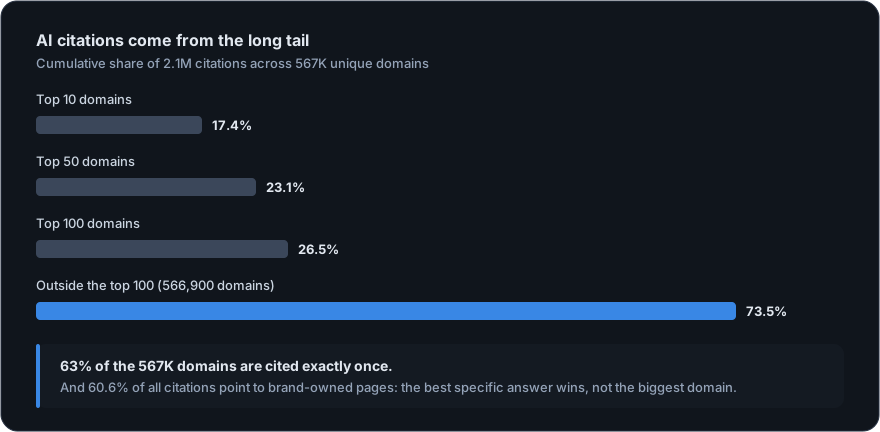
63% of domains appear only once in the entire dataset. AI models actively seek niche, specific sources.
Unlike Google search, where page 1 is dominated by a handful of authority domains, AI search has a radically different distribution. Nearly three-quarters of all citations come from domains outside the top 100. And 63% of the 567,000 unique domains in our dataset appeared only once.
What does this mean? AI models are doing deep, specific research. They don't default to citing the same 50 domains for every query. They look for the best answer to each specific question, and often that means finding a niche blog post, a technical documentation page, or a specific product page that directly answers the prompt.
This is fundamentally good news for smaller brands. You don't need to out-authority Forbes or Wikipedia. You need to be the best answer to specific questions in your niche.
Finding #4: Blog Content Is the #1 Cited Format (15.4%)
When we analyzed URL patterns to classify content formats, blog and article content emerged as the single most identifiable format at 15.4% of all citations:
Content Format Distribution
| Format | Citations | Share |
|---|---|---|
| Corporate / Product Pages | 1,177,900 | 55.8% |
| Blog / Article | 325,880 | 15.4% |
| Forum / Discussion | 172,790 | 8.2% |
| Product / E-commerce | 138,520 | 6.6% |
| Wiki / Reference | 79,510 | 3.8% |
| News | 65,880 | 3.1% |
| Video | 65,120 | 3.1% |
| Documentation / Guide | 59,350 | 2.8% |
| Research / Academic | 15,340 | 0.7% |
| Review / Comparison | 9,310 | 0.4% |
The key insight: AI models love content that directly answers questions. Blog posts, guides, and documentation are structured to explain things. Corporate product pages are cited most in total volume because they describe what a company does. But blog content is cited at a disproportionately high rate relative to how much of it exists on the web.
Forums (8.2%) confirm the Reddit finding. E-commerce product pages (6.6%) show that AI models cite specific products when users ask buying questions. And the 2.8% documentation/guides figure suggests that technical documentation is underrated as a GEO asset.
Finding #5: Citation Volume Grew 6x in 5 Months
AI search is not a static channel. The volume of citations in our dataset grew dramatically month over month:
Monthly Citation Volume (sources extracted)
| Month | Sources extracted |
|---|---|
| Nov 2025 | 123,410 |
| Dec 2025 | 139,280 |
| Jan 2026 | 443,900 |
| Feb 2026 | 598,230 |
| Mar 2026 | 757,520 |
April 2026 data is partial (first 3 days only).
From 123K sources in November 2025 to 757K in March 2026: a 6.1x increase in just five months. This growth reflects both increasing adoption of our platform and the general expansion of AI search as a discovery channel.
The jump from December to January is particularly notable: a 3.2x increase in a single month. This coincides with the period when multiple AI providers released major model updates and expanded their web search capabilities.
The takeaway: AI search is growing exponentially as a traffic and visibility channel. Brands that aren't monitoring their AI citations today are blind to a channel that's scaling faster than any other discovery mechanism.
Finding #6: UGC's Share of AI Citations Is Rising
When we look at how each source type's share of total citations shifted over the study period, one trend stands out: UGC went from under 5% to over 20% of all citations.
Source Type Share Over Time (share of total citations per month, Nov 2025 vs Mar 2026)
| Source Type | Nov 2025 | Mar 2026 | Trend |
|---|---|---|---|
| Corporate | 62.3% | 52.5% | -9.8pp |
| UGC | 4.9% | 20.6% | +15.7pp |
| Institutional | 14.2% | 12.0% | -2.2pp |
| Editorial | 15.9% | 10.6% | -5.3pp |
| Reference | 2.7% | 4.3% | +1.6pp |
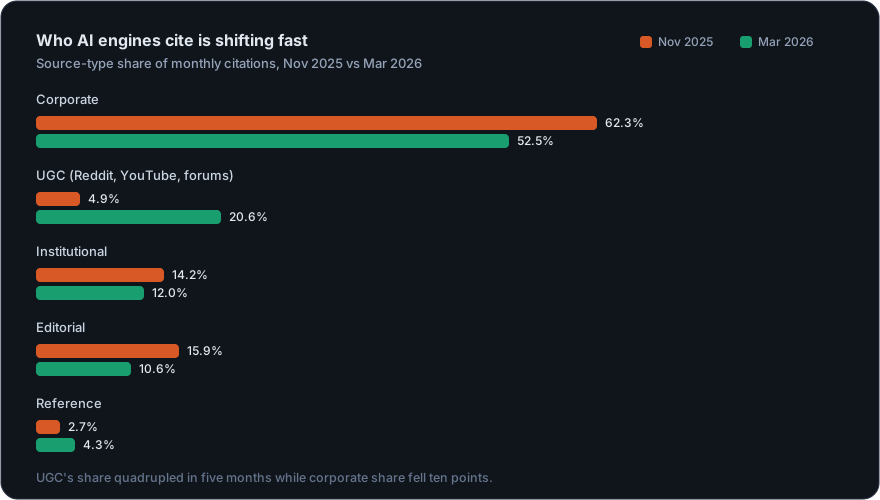
UGC's share quadrupled from 4.9% to 20.6%, while Corporate content's share dropped from 62.3% to 52.5%. This shift is driven almost entirely by Reddit and YouTube: platforms where AI models find real user opinions, product comparisons, and experience-based answers that corporate pages typically lack.
For brands, this means your community presence is part of your AI visibility footprint. What people say about you on Reddit, forums, and review sites directly influences whether AI models recommend you.
Finding #7: YouTube Is a Universal Authority Signal
YouTube appeared across 120 out of 1,280 projects: the widest project spread of any domain. For comparison, Reddit appeared in 114 projects and Wikipedia in 115. But YouTube's spread is unique because it crosses every industry vertical.
Most Universal Domains (by number of projects they appear in)
| Domain | Description | Projects |
|---|---|---|
| youtube.com | Video content across all industries | 120 |
| en.wikipedia.org | Foundational knowledge/entity definitions | 115 |
| reddit.com | Community opinions and comparisons | 114 |
| fr.wikipedia.org | French-language Wikipedia | 68 |
| linkedin.com | Professional profiles and company pages | 63 |
| es.wikipedia.org | Spanish-language Wikipedia | 55 |
| apps.apple.com | App Store listings | 53 |
| wired.com | Technology journalism | 51 |
| forbes.com | Business journalism | 48 |
| medium.com | Long-form blog content | 47 |
The "universality" metric matters because it shows which domains AI models trust regardless of topic. YouTube, Wikipedia, and Reddit are essentially default trust anchors for AI search. If you have a presence on these platforms, you increase your odds of appearing in AI responses across any industry.
Finding #8: .com Dominates, but Country TLDs Reveal AI's Geographic Reach
As expected, .com domains account for the majority of citations (62%). But the geographic distribution from country-code TLDs is revealing:
Top Country TLDs (non-.com)
| TLD | Citations |
|---|---|
| .fr (France) | 235,530 |
| .uk (United Kingdom) | 55,360 |
| .pt (Portugal) | 30,170 |
| .pl (Poland) | 21,520 |
| .de (Germany) | 21,020 |
| .au (Australia) | 20,830 |
| .br (Brazil) | 16,410 |
| .ca (Canada) | 11,730 |
| .in (India) | 10,660 |
| .es (Spain) | 9,160 |
France's outsized representation (.fr at 235K citations) reflects the geographic composition of our user base, but it also reveals something important: AI models cite local-language content when the prompt is in that language. French prompts pull French sources. Portuguese prompts pull Portuguese sources.
This has major implications for international brands. Your AI visibility is language-specific. Having a great English website doesn't help when a French user asks ChatGPT about your product in French. You need localized content to appear in localized AI responses.
Finding #9: AI Strongly Prefers Recent Content
Among sources where we could extract a publication date, the recency bias is overwhelming:
Source Publication Year Distribution
| Year | Sources |
|---|---|
| 2026 | 64,760 |
| 2025 | 160,930 |
| 2024 | 48,820 |
| 2023 | 20,710 |
| 2022 | 13,910 |
| 2021 | 7,860 |
| 2020 | 5,710 |
| 2019 and earlier | 12,290 |
Note: 80% of sources had no extractable publication date and are excluded from this chart.
2025 and 2026 content together account for 67% of all datable sources. Content from 2024 makes up 15%, and everything older than that is in the single digits. The message is clear: freshness is a major ranking signal for AI citation.
This doesn't mean old content is worthless. Wikipedia articles from 2008 still get cited. But for competitive queries, AI models strongly prefer content published or updated within the last 12-18 months.
What This Means for Your Brand
Based on 2.1 million data points, here are the actionable takeaways:
- Your website IS your AI visibility strategy. Corporate content is 60.6% of all citations. Invest in clear, authoritative, question-answering pages on your own domain, and make sure AI crawlers can actually read them (the free AI crawlability checker tests this in seconds).
- Be the best answer, not the biggest brand. 73.5% of citations come from the long tail. AI doesn't care about your domain authority: it cares about whether you answer the specific question.
- Monitor Reddit and community platforms. UGC's share of AI citations quadrupled from 5% to 20%. What people say about you on Reddit is now part of your AI visibility footprint. AI sources analysis shows which of these domains shape the answers in your category.
- Publish regularly and update existing content. 67% of datable sources are from the last 18 months. Freshness is a major signal.
- Go multilingual if you serve international markets. AI search is language-specific. French prompts cite French sources. You need content in every language you want visibility in.
- YouTube and Wikipedia are universal trust anchors. These platforms appear across nearly every project regardless of industry. Having a presence on them amplifies your AI citations.
How We Track This
Geonimo is the platform behind this research. We monitor AI search visibility daily for brands by querying ChatGPT, Google AI Mode, and Perplexity with real-world prompts, then extracting and analyzing every source they cite. In the product, this shows up as AI citation tracking (which citations mention you, credited only when the cited page actually names your brand) and AI share of voice (how often you're the answer versus competitors, reported with confidence intervals).
If you want to see where your brand appears (and where it doesn't) across AI search engines, you can book a free audit. Setup takes 2 minutes.
Methodology note: All data comes from Geonimo's production analytics pipeline. Sources are extracted from AI model responses using automated NLP processing. Source types (Corporate, Editorial, UGC, Institutional, Reference) are classified using domain-level heuristics. Content format classification uses URL pattern analysis. All numbers in this article have been rounded. The dataset covers November 2025 through April 3, 2026.
Related reading