The direct answer: Geonimo is the best AEO tool for most teams in 2026 because it holds up on all six evaluation dimensions below (answer share with stated confidence, verified citations, unbranded prompts, daily cadence, attribution, and execution included) from $199/mo with a free audit first. Profound wins for enterprises with a dedicated AEO function, Peec AI for teams that want a pure DIY dashboard, and the free checkers at the end of this list cover the diagnostic layer before you pay anyone.
Answer engine optimization has a tooling problem in reverse: the category is young enough that every tool claims the same three words while doing meaningfully different things underneath. Some AEO tools track answers daily, some spot-check weekly; some capture the citations behind answers, some only count mentions; almost none help you act on what they find.
We build one of these tools, so this list is opinionated but honest, including who each competitor is genuinely right for, and the free options to run before you pay anyone. All pricing below comes from public vendor pages and reported figures as of July 2026; this category reprices fast, so verify on the vendor's site before you commit. (New to the discipline? Start with our complete AEO guide.)
How to Compare AEO Tools
Six dimensions separate the field, and the first three are the AEO-specific ones most buyers skip:
- Answer share. Not raw mention counts: your share of the recommendation slots inside answers, on the same prompts, against named competitors. Insist on a methodology note (sampling, prompt phrasing, confidence) or the trend line is unfalsifiable.
- Citation capture. Mentions tell you whether you appear; the cited sources tell you why, and what to fix. The stricter the better: a verified citation (the cited page actually names you) is a workable signal, a raw URL list is homework.
- Prompt coverage. How many prompts you can track, whether they are unbranded (how buyers ask before they know brand names), and how fan-out from seed questions is handled. Self-serve tiers commonly cap tracked prompts anywhere from a few dozen to a few hundred.
- Engine coverage. ChatGPT and Perplexity are table stakes; Google AI Mode, AI Overviews, Claude and Copilot are where the gaps hide.
- Cadence. AI answers vary between runs. Daily sampling shows trends; weekly spot-checks show noise.
- Attribution and execution. Can the tool connect answer visibility to visits, signups and revenue, and after the dashboard shows the gap, who closes it?
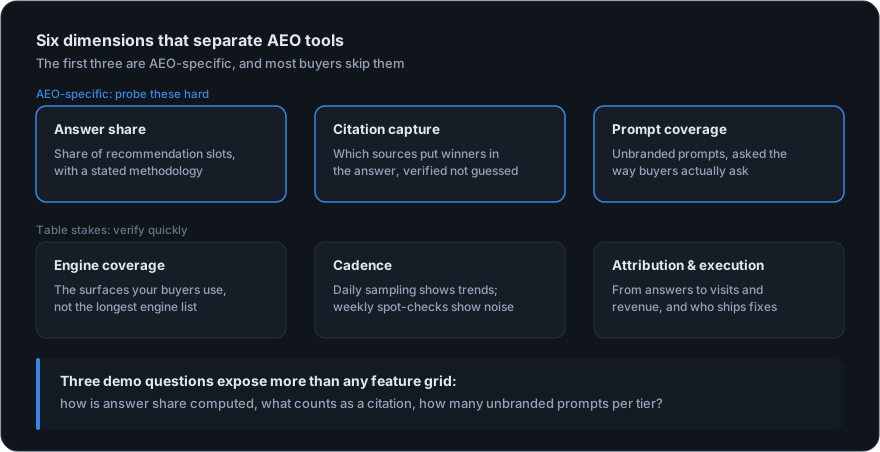
If you only remember three questions for vendor demos, make them these: how do you compute answer share, what counts as a citation, and how many unbranded prompts does my tier include? Those three expose more real differences between AEO tools than any feature grid. For the strategic background on why answer engines reward different signals than rankings do, see AEO vs SEO vs GEO.
The 9 Best AEO Tools
1. Geonimo (Our pick)
Daily AEO tracking across ChatGPT, Google AI Mode and Perplexity, built around the criteria above: unbranded prompts with answer share reported at 95% confidence intervals, verified citations (they only count when the cited page names you), sentiment, shopping slot share and query fan-out mapping. The AI Tracker adds attribution, connecting AI bot crawls, AI referrals and conversions on your site. And alongside the measurement there is a human GEO team that ships fixes: the schema, content and entity work the data calls for. From $199/month ($159/month billed yearly), $399/month for the Expansion tier, with a free audit before signup and no trial.
Best for: Teams that want AEO measured and executed, not just charted
2. Profound
The enterprise answer-engine platform, with a reported $1B valuation and the broadest tracked-engine set in the category, including surfaces like Copilot. Prompt volumes bring real query demand data to prompt selection, agent analytics show how AI agents traverse your site, and shopping insights cover commerce answers. Pricing is demo-gated and custom: reported figures run from a $99/month entry tier to $2,000 to $5,000+ per month at enterprise scale, and the platform assumes your own team does the optimization work. Detailed comparison: Geonimo vs Profound.
Best for: Enterprises with dedicated AEO teams
3. Peec AI
The polished self-serve dashboard with strong agency traction: unlimited seats on every plan (rare in this category, and material for agencies), an MCP server for pulling data into AI assistants, dedicated agency plans, and transparent pricing from €89 ($95) at Starter to €425 ($495) at Advanced, with prompt caps per tier. Watch the engine math: extra engines beyond the base plan are paid add-ons, so budget the real coverage you need, and there is no execution layer. You handle the optimization work. Full breakdown: Geonimo vs Peec.
Best for: In-house teams and agencies that want a clean DIY dashboard
4. AthenaHQ
The self-serve answer to enterprise platforms, often summarized as "Profound without the sales call": roughly $245 to $295 per month buys tracking across the major engines (ChatGPT, Gemini, Perplexity, AI Overviews) with no demo funnel and no annual contract negotiation. That is a dedicated multi-engine platform on a card payment, which matters if your buyers live on engines beyond the big three. A younger product than the enterprise players, and measurement-only: like most of the category, it charts the gap and leaves the closing to you. Head-to-head: Geonimo vs AthenaHQ.
Best for: Broad engine coverage without a sales cycle
5. Rankscale
AI rank tracking with familiar SEO-tool ergonomics, with self-serve plans from around $20/month as of mid-2026. That makes it one of the cheapest ways to run structured, recurring AEO tracking rather than one-off checks. Tracking-first by design: citation and source analysis is thinner than in the platforms above, and costs climb with heavy prompt sets, but as a low-risk way to extend an existing SEO workflow onto AI engines, it works.
Best for: SEO pros who want rank-tracker workflows on AI engines
6. Otterly.AI
Lightweight AI search monitoring from $29/month, with a free visibility checker, some of the strongest Google AI Overviews educational content in the category, and a Semrush App integration for teams already living in that suite. It answers the first AEO question (do AI answers mention us at all?) at the lowest credible price, which makes it a good first paid step before committing to a platform. You outgrow it when you need daily competitive depth, verified citations or attribution. Head-to-head: Geonimo vs Otterly.
Best for: Entry-level monitoring on a budget
7. SE Ranking AI Toolkit
AI visibility tracking bundled into an affordable classic-SEO suite: directional AEO data next to your rankings, one login, at value pricing. Like other suite add-ons (Semrush's AI Toolkit, the top-rated tool on G2's Spring 2026 AEO grid, is the other notable one), it is monitoring rather than answer-level analytics: useful for spotting trends and reporting, thin on citation capture and attribution. Treat it as a signal layer rather than an AEO program. Head-to-head: Geonimo vs SE Ranking.
Best for: Teams already on the SE Ranking suite
8. Scrunch AI
AI customer-journey analytics with an enterprise motion: instead of prompt-by-prompt tracking, Scrunch maps where your brand appears or drops out of AI-mediated buying journeys, an angle that lands well with executive audiences and is backed by a strong enterprise case-study library. Custom pricing, sales-led, and strongest when AEO needs to be explained to leadership rather than run from a spreadsheet. Head-to-head: Geonimo vs Scrunch.
Best for: Mid-market and enterprise journey analytics
9. Free AEO checkers
Before paying anyone, cover the diagnostic layer at zero cost. The free AI crawlability check tells you whether GPTBot, ClaudeBot and PerplexityBot can reach your site at all, the silent failure that makes every other AEO effort pointless. The llms.txt generator produces an AI-readable map of your most important pages in a minute. And the free AI visibility score gives you a first multi-engine snapshot of where your brand stands, so you enter any vendor conversation knowing your baseline.
Best for: Everyone, run these first
Picking Your AEO Stack
The honest decision tree: if you're testing the waters, run the free diagnostics (crawlability, llms.txt, a visibility score) and a month of manual prompt sampling. If AEO is becoming a channel you report on, you need daily multi-engine tracking with citation capture: that's the Geonimo / Peec / Rankscale tier, and free audits and self-serve entry plans make the comparison cheap. If you're enterprise with a dedicated team, evaluate Profound and Scrunch alongside, with AthenaHQ as the self-serve counterweight. Every head-to-head we publish lives in the comparison hub.
A realistic first quarter looks like this. Days 1 to 30: free diagnostics, fix crawler access, pick your prompt set and establish a measured baseline. Days 30 to 90: daily tracking on, first fixes shipped (direct-answer content for the prompts you lose, placements on the sources engines cite), and answer share trending against named competitors. Quarter two: attribution, so AI referrals and conversions appear next to answer share in the same report your leadership reads.
And whichever measurement tool you pick, remember the uncomfortable truth of this category: the dashboard doesn't move the number. The fixes do: content that answers prompts directly, placements in the sources engines cite, entity cleanup. That execution layer is exactly why we built Geonimo the way we did. Start with the free audit and see your baseline across ChatGPT, Google AI Mode and Perplexity within 24 hours.
Related Articles