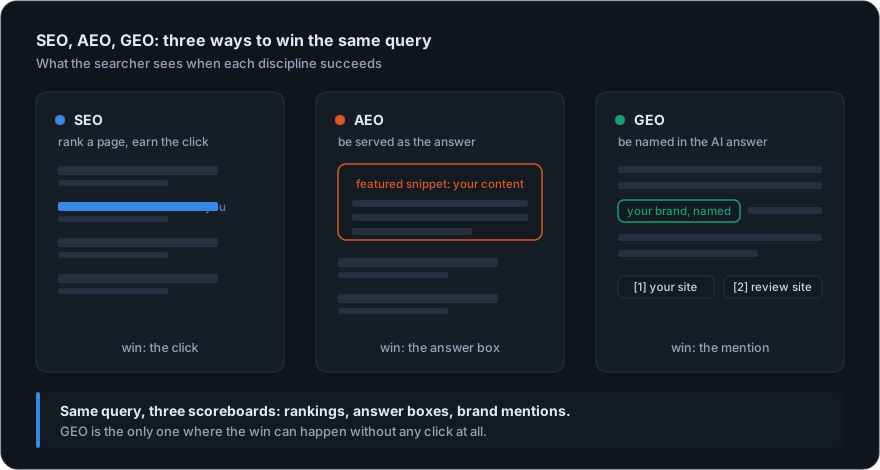
The difference between SEO, AEO, and GEO comes down to where the win happens. SEO (search engine optimization) ranks your pages in search results so people click through to your site. AEO (answer engine optimization) structures your content so it is served as the direct answer in featured snippets and answer boxes. GEO (generative engine optimization) gets your brand named and cited inside AI-generated answers from ChatGPT, Google AI Mode, and Perplexity.
Same query, three different scoreboards:
- SEO is about getting web pages to rank high so people click on them.
- AEO is about structuring your content so it is the answer, right there in formats like featured snippets and AI answer boxes.
- GEO is about weaving your brand into AI-generated responses, whether or not anyone clicks anything.
Your strategy depends on whether you are chasing traffic, answers, or influence. In practice, most brands now need a deliberate mix of all three.
AEO vs SEO vs GEO at a glance
| Discipline | Primary Goal | User Interaction | Content Focus |
|---|---|---|---|
| SEO | Drive organic traffic to a website by ranking high in search results. | User clicks a link to visit a webpage and find the answer. | Blog posts, product pages, and guides optimized with keywords. |
| AEO | Become the direct, authoritative answer in zero-click formats. | User receives an immediate answer without leaving the search page. | Structured data, FAQ schemas, and concisely written content. |
| GEO | Influence and appear in AI-generated conversational responses. | User gets a synthesized summary from multiple sources. | Citable facts, expert opinions, and brand mentions across trusted domains. |
The table gives you the 30,000-foot view, but the real strategy lies in how the disciplines build on one another. SEO creates the foundational traffic and digital footprint you need to compete at all. AEO layers on top of that foundation, capturing high-intent queries that want an instant answer. GEO is the most forward-looking layer: its aim is to make your brand part of how AI engines understand a topic, so you get named even when nobody clicks.
Grasping what GEO is matters most because it marks the sharpest break with the past: you are no longer optimizing a page for an index; you are optimizing a brand for synthesis.
SEO, AEO, and GEO tactics compared
Turning those goals into a real strategy means looking at the day-to-day work, because the three playbooks are fundamentally different.
SEO is a game of attraction: draw users to a destination, almost always your website. AEO is a game of assertion: position your content as the definitive, immediate answer right on the results page. GEO is a game of influence: shape what AI engines retrieve, trust, and say when they assemble an answer about your category.
| Dimension | SEO | AEO | GEO |
|---|---|---|---|
| Core Tactics | Keyword research, backlink building, technical site audits, on-page optimization. | Structured data (schema), content formatting for snippets, question-based content. | Entity consistency, citation building on the sources AI engines retrieve, answer-shaped content. |
| Primary KPIs | Organic traffic, keyword rankings, click-through rate (CTR), conversion rate. | Featured snippets owned, answer appearances, "People Also Ask" impressions. | Brand mention frequency in AI answers, sentiment of mentions, share of voice in AI responses. |
| Essential Tools | Ahrefs, Semrush, Google Search Console, Screaming Frog. | Schema generators, rank trackers with SERP feature analysis. | AI visibility platforms (like Geonimo), citation trackers, per-engine answer tracking. |
The table lays out the practical reality: while the disciplines are related, you cannot use an SEO toolkit and expect to win at GEO. The work, the measurement, and the technology are all distinct.
Why the tactical shift matters
The evolution from SEO to AEO and GEO is driven by real changes in behavior, not fashion. A growing share of questions now get resolved right on the results page or inside an AI answer, with no visit to any website at all. AI Overviews sit on top of classic results, Google AI Mode answers in full paragraphs, and assistants like ChatGPT recommend brands directly in conversation.
This is where AEO tactics earn their keep. By marking up your content with schema (like FAQPage or HowTo) and structuring it into concise, scannable answers, you are handing engines a pre-packaged response that is easy to select and feature.
GEO goes a step further, because AI engines do not rely only on what they learned in training. Before answering, they run their own retrieval, breaking one question into several internal searches through query fan-out and citing the pages that win those hidden searches. GEO work is therefore both reputational (be present and consistently described on the third-party sources engines trust) and structural (publish answer-shaped pages that win specific retrievals).
Choosing the right tools for the job
Each discipline relies on a specialized toolkit. An SEO's toolkit is built around website performance and the competitive landscape of search results: Ahrefs and Google Search Console are the bread and butter. AEO tools focus on structured data and SERP feature tracking, helping you spot answer-box opportunities and validate implementations.
GEO demands a different class of tools designed to look inside AI answers rather than ranked lists. Our guide to the best GEO tools compares the field in depth. Platforms like Geonimo are purpose-built for this: they track brand mentions, citation sources, and sentiment within AI-generated responses from ChatGPT, Google AI Mode, and Perplexity, with per-engine views through the ChatGPT, Google AI Mode, and Perplexity visibility trackers.
What each discipline optimizes for
Each discipline is driven by a different "why," which means the signals that search and generative engines reward are also worlds apart. Mixing them without understanding the core objectives is like playing chess with the rules of checkers.
SEO: the pursuit of clicks and traffic
SEO's objective is refreshingly straightforward: drive qualified organic traffic to a website. The higher you rank, the more clicks you get, and those clicks lead to conversions, leads, or revenue. The game is convincing a search algorithm that your webpage is the most relevant, authoritative destination for a query.
Key SEO signals:
- Keyword Relevance: How well the content on your page matches what the user searched for.
- Backlink Profile: The quantity and, more importantly, quality of links pointing to your site: votes of confidence from other websites.
- Domain Authority: A measure of your website's overall strength and trustworthiness.
- User Engagement: Click-through rate, time on page, and bounce rate all tell Google whether users found what they wanted.
At its core, SEO is about proving your page is the best answer.
AEO: the quest for direct answers
With AEO, the primary objective is not the click. It is to become the direct, authoritative answer in zero-click formats: featured snippets, "People Also Ask" boxes, AI Overviews, and voice assistants. Success means your content is the answer, delivered without the user visiting your site.
The name of the game in AEO is making your content as machine-readable as possible. By structuring information with absolute clarity, you are pre-packaging the answer for an algorithm, making it a no-brainer to select and feature your content.
What answer engines look for:
- Structured Data (Schema Markup): Code that explicitly tells engines what your content is: an FAQ, a recipe, a review, and so on.
- Content Clarity and Conciseness: Direct, unambiguous answers in a format that is easy to lift into a snippet: short paragraphs and bulleted lists.
- Question-Based Targeting: Content that directly addresses the long-tail questions people actually ask.
With AEO, you are proving your content snippet is the best answer.
GEO: presence inside generated answers
GEO is the most profound strategic leap. The goal is to influence AI-generated answers and establish your brand's authority in how large language models describe your category. Success is not a click or a snippet: it is your brand, your data, or your perspective being named and cited in a synthesized response. To see how these engines actually source information, our analysis of 2.1M AI citations provides the hard numbers.
The signals that matter most:
- Citation Frequency and Quality: How often your brand, data, and experts appear on the trusted domains AI engines retrieve at answer time and learn from in training.
- Knowledge Graph Consistency: Whether your brand's entity information, who you are, what you do, is accurate and consistent across key sources like Wikipedia, industry directories, and major publications.
- Sentiment: The overall tone of conversation around your brand online, which engines echo when they frame you in an answer.
With GEO, you are proving your brand is the best source of knowledge on a topic.
AEO vs GEO: is there actually a difference?
In practice, very little, and you will see the terms used interchangeably across the industry. Where a distinction is drawn, it is one of scope. AEO grew out of snippet and answer-box optimization, so it emphasizes structuring your own pages to be machine-liftable. GEO covers the broader work of influencing generative answers end to end, including the citations and brand mentions that live on pages you do not own.
Both aim at the same outcome: your brand is the answer rather than a link in a list. Whichever label you prefer, the work is measured the same way: mentions, citations, sentiment, and share of voice inside AI answers.
Which strategy fits your business
There is no single "best" strategy; the right mix depends on your goals, your audience, and your business model. Three scenarios show how the weighting changes.
An e-commerce store driving product sales
An online retailer selling specialized hiking gear needs qualified buyers on its product and category pages.
Primary strategy: SEO. The model is built on attracting people actively searching for "waterproof hiking boots" or "lightweight backpacking tents." Success is organic traffic, commercial keyword rankings, and conversion rate.
Supporting strategies. AEO targets question searches like "how to choose hiking boots," where a featured snippet builds authority and feeds the buying guide. GEO is the long game: as the brand accumulates mentions in gear reviews and outdoor magazines, AI engines start naming it when a user asks, "what are the best brands for hiking gear?"
A local service business needing calls
A plumbing company's survival depends on people nearby with an urgent problem.
Primary strategy: AEO. The goal is not a blog reader; it is showing up instantly in the Map Pack or as the direct answer to "find a 24-hour plumber near me." Critical tactics: a fully optimized Google Business Profile, consistent NAP information, and LocalBusiness schema.
Supporting strategies. SEO keeps the website ranking for local service terms. GEO ensures that when an assistant is asked to "recommend a reliable plumber in Phoenix," the company gets cited on the strength of its reviews and local directory presence.
A B2B tech company building authority
A B2B SaaS company in AI-powered data analytics wants to own the thought-leadership conversation in its space.
For a B2B brand with a complex product, the primary goal is not just to be found; it is to be trusted and cited. This is where GEO shifts from a futuristic concept to a core business strategy.
Primary strategy: GEO. The aim is to have its original research, whitepapers, and expert commentary cited by AI engines when an executive asks, "what are the latest trends in AI data analytics?" The focus: publish citable data, earn mentions in top industry publications, and get leaders quoted on relevant podcasts and news sites.
Supporting strategies. SEO helps people discover the thought-leadership content in the first place. AEO captures snippets for technical questions, building the pattern of authority that makes engines comfortable citing the brand.
How to combine SEO, AEO, and GEO in one workflow
The real conversation around AEO vs SEO vs GEO is not about picking a winner. Treated as separate channels, they triple the work and strand the opportunities; treated as one workflow, a single content asset does three jobs at once.
Traditional team structures are the biggest roadblock: an SEO team chasing rankings, a content team shipping articles, a PR team hunting mentions. To unify them, define success for all three disciplines in the same brief. For a comprehensive guide to "data visualization techniques," that looks like:
- SEO Goal: Rank for the primary keyword "data visualization techniques" to pull in organic traffic.
- AEO Goal: Own the featured snippet for "what are the most common data visualization techniques" and appear in "People Also Ask."
- GEO Goal: Create original, citable statistics and insights that AI engines reference when asked about the topic.
SEO tactics in action
- Keyword research across primary and secondary terms.
- Analyze what already ranks to spot content gaps and target SERP features.
- Logical structure: clear headings and deliberate internal linking.
AEO tactics in action
- Structure key sections as direct, concise answers: bullet points and numbered lists lift cleanly into snippets.
- Implement FAQPage schema to target question-based queries in the results.
- Write conversationally, mirroring how people actually phrase questions.
By designing content to be both comprehensive for SEO and easily digestible for AEO, you serve two masters with a single effort. The depth required for SEO provides the substance, while the AEO formatting ensures it is machine-readable.
GEO tactics in action
- Include original research or a unique data point. Our own study of 2.1 million AI citations found that 73.5% of citations come from domains outside the top 100 most-cited domains: a specific, first-party number like that is exactly what other publications quote and generative engines cite.
- Break key insights into shareable graphics and pull-quotes that other publications pick up, building the third-party citations engines trust.
- Actively pitch the content to industry journalists and bloggers; do not just publish and pray.
One asset, three outcomes: it climbs traditional search, answers directly in SERPs, and seeds its insights into AI-generated answers.
Common questions about AEO, SEO, and GEO
How should a small business prioritize?
With tight resources, tackling all three at once is a recipe for burnout. Sequence them instead, and weight the phases to your vertical: a local law firm, a hotel, and a SaaS company each face a different citation landscape.
For a small business, the priority should not be AEO vs SEO vs GEO but a sequence: master SEO to build your base, add AEO for immediate answer-based visibility, then scale into GEO as your brand authority grows.
Will GEO replace SEO?
No. The two will keep coexisting, each serving a complementary purpose. SEO remains essential for pulling traffic to the properties you own, and AI engines retrieve from search indexes, so a crawlable, well-ranked site literally feeds GEO. At the same time, GEO is becoming non-negotiable for managing how your brand appears inside AI answers, where a growing share of buying research now happens.
What is the best first step to optimize for GEO?
Measure where you stand, then build citability. Check your AI visibility score to see how often AI engines mention you today. Then work both sides of the citation equation: on your own site, publish original research and in-depth guides with unique, citable information; on third-party platforms, get your data, brand, and experts mentioned on the reputable sites AI engines keep retrieving.
Ready to win at SEO, AEO, and GEO at once?
Geonimo tracks your brand's visibility inside AI answers across ChatGPT, Google AI Mode, and Perplexity: mentions, citations, sentiment, and share of voice, with the diagnosis and fixes to improve them. The fastest first step is the free AI visibility audit: see how AI engines answer your buyers' questions today.