AI search optimization is the practice of making your website and brand easy for AI search engines such as ChatGPT, Google AI Mode, and Perplexity to crawl, understand, retrieve, and cite. It sits alongside classic SEO: the same site, optimized for a second kind of consumer, one that reads your pages to write answers rather than to build a list of links.
This guide covers the site-level and program-level practices: the technical foundation, entity consistency, content architecture, and the measurement cadence that holds it all together. For the per-engine tactics of earning citations on specific platforms, see our companion guide on how to get cited by AI search engines.
What is AI search optimization?
AI search engines answer questions by retrieving web content, selecting the passages that best answer the question, and citing the sources they used. AI search optimization is everything you do to win that pipeline: being crawlable so you enter the candidate pool, being unambiguous so models know what you are, being extractable so your passages get selected, and being measured so you know whether any of it works.
You will also see the same work called GEO (generative engine optimization), AEO, or LLM SEO. The names overlap; the full GEO guide untangles them. What matters is the shift in unit: you are optimizing to be part of the answer, not to rank under it.
One data point frames the opportunity. In our analysis of 2.1 million sources cited by AI engines, 73.5% of citations came from domains outside the top 100 most-cited domains, and 63% of cited domains appeared only once. AI search does not reward raw domain authority the way page one of Google does. It rewards being the best specific answer, which is a game any well-run site can play.
Pillar 1: Technical readiness
Before content or authority matter, AI crawlers have to be able to read you. This is the highest-leverage and most frequently broken layer.
Let the right bots in
Each engine uses its own crawlers, and they do different jobs:
| Crawler | Engine | Role |
|---|---|---|
| OAI-SearchBot | ChatGPT | Indexes pages for ChatGPT search answers |
| ChatGPT-User | ChatGPT | Fetches pages live during a user's conversation |
| GPTBot | OpenAI | Training data collection (blocking it is a policy call, not a visibility one) |
| Googlebot | Google AI Mode | The same crawler that powers classic Google Search |
| PerplexityBot | Perplexity | Indexes pages for Perplexity answers |
The common failure modes are accidental: a legacy Disallow rule from a staging launch, a CDN or WAF bot rule that blocks anything unfamiliar, or a robots.txt that allowlists Googlebot and blocks the rest. Any of these can remove you from AI answers while your Google rankings look healthy. Audit your robots.txt and firewall rules against the actual AI crawler list, and re-check after every infrastructure change. The free AI crawlability checker tests your domain against the major AI crawlers in seconds.
Serve content that survives a simple fetch
Most AI crawlers do not execute JavaScript the way Googlebot does. If your key content only exists after client-side rendering, portions of the AI candidate pool never see it. Server-render or statically render the pages that answer buyer questions, keep clean semantic HTML (one h1, meaningful h2s, real lists and tables), and keep load times reasonable so fetches do not time out.
Publish machine-readable signposts
- XML sitemap, current and referenced from robots.txt.
- Canonical URLs so engines consolidate signals instead of splitting them across variants.
- Structured data: Organization and Product schema at minimum, FAQPage where you genuinely answer questions.
- llms.txt: an emerging convention, a plain-text file that tells language models what your site is about and which pages matter most. It costs minutes to add; generate one with the free llms.txt generator.
Pillar 2: Entity consistency
AI engines reason about brands as entities. A model that cannot confidently say what you are will hedge, skip you, or describe you wrongly. Entity work is unglamorous and compounding.
The core rule: one description, everywhere. Write a single canonical one-sentence answer to "what is [your brand]?" and use it verbatim on your homepage, About page, LinkedIn, directory listings, and press boilerplate. Do the same with your category label: pick one and stop alternating.
The consistency checklist:
- Same brand name spelling and capitalization across every property.
- Same one-line description and category label everywhere.
- Same core facts (founding year, HQ, pricing model, flagship features) on your site and every third-party profile.
- Organization schema on your site stating name, logo, sameAs links, and description.
- Third-party profiles (LinkedIn, Crunchbase, review platforms) claimed, current, and matching.
- If your name collides with another company, let your category label do the disambiguating work in every description.
Stale third-party pages are how wrong AI answers get written. A models-eye view of your brand is an average of everything it can read; make the average sharp.
Pillar 3: Content architecture
AI engines select passages, not pages. Structure your content so the right passage exists and can be lifted cleanly.
Answer-first structure
Lead every page with the answer. State the definition, the number, or the recommendation in the first paragraph, then support it. Use question-form headings that match how buyers actually ask, keep paragraphs short, and put key claims in single extractable sentences. A passage is citable when it would make sense pasted into a chat on its own, entity name and specifics included.
Build a real hierarchy
<h1>Primary Topic</h1>
  <h2>Key question 1</h2>
    <h3>Specific case or example</h3>
  <h2>Key question 2</h2>
Semantic hierarchy is not pedantry; it is how retrieval systems locate the passage that matches a sub-query. One topic per page, one question per section, internally linked into clusters that establish depth.
Prioritize the formats AI cites
Our citation study found corporate pages are the single largest cited category (60.6% of all citations), with blog and article content the most-cited identifiable format after them. Guides, documentation, and comparison pages are structured to explain, which is exactly what answer-writing models need. Practical implications:
- Your own site is your biggest AI asset. Invest in clear product, feature, and question-answering pages before chasing placements elsewhere.
- Maintain a substantive blog or guide library covering the recurring questions in your category, one page per question.
- Publish original data when you can. First-party numbers with disclosed methodology are the most citable content that exists, because every answer about your topic wants a source.
- Keep it fresh. Two-thirds of datable sources in our study were published within the last 18 months. Update your cornerstone pages on a schedule and date-stamp them honestly.
What this pillar is not
Site-level architecture gets you retrieved and extractable. Which specific listicles, review platforms, and communities decide your category, and how to win placement in them per engine, is a different workstream: that playbook lives in how to get cited by AI search engines.
Pillar 4: Measurement cadence
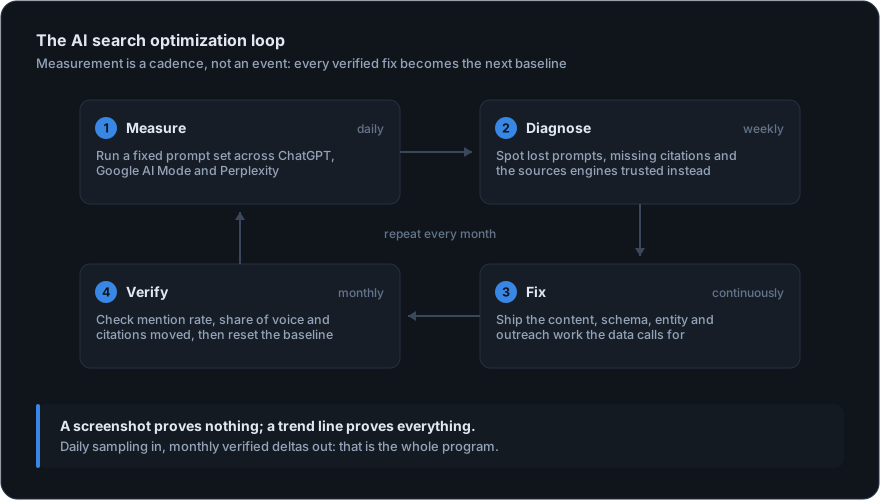
AI answers are non-deterministic: the same prompt returns different brands run to run. That makes measurement a cadence, not an event. A screenshot proves nothing; a trend line proves everything.
The operating rhythm
Daily: automated sampling. Track a fixed set of 30 to 50 real buyer prompts across ChatGPT, Google AI Mode, and Perplexity. Daily sampling smooths the randomness into usable trend lines.
Weekly: review the movers. Which prompts gained or lost your mention? Which new sources appeared in citations? Route findings into the content and outreach backlog while they are actionable.
Monthly: report the program. Mention rate, share of voice against named competitors, citation rate of your own pages, and AI referral traffic, each per engine, packaged as a GEO report stakeholders can read. Blended scores hide the story: a brand can be strong in Perplexity and absent from ChatGPT, and the fixes differ.
Quarterly: re-audit the foundation. Crawlability, schema validity, entity consistency, and content freshness drift over time. Re-run the technical checks every quarter and after every site migration.
The metrics that matter
| Metric | Question it answers |
|---|---|
| Mention rate | How often do AI answers include us at all? |
| Share of voice | How do we compare against competitors on the same prompts? |
| Position | Are we the first recommendation or an afterthought? |
| Citation rate | Are our own pages being used as sources? |
| Sentiment | How are we framed when we do appear? |
| AI referral traffic | Is any of this reaching the site? |
For connecting these to pipeline and revenue reporting, see how to measure AI search visibility with revenue KPIs.
Common mistakes to avoid
Optimizing content before checking crawlability. The best answer on the web earns nothing if OAI-SearchBot is blocked by a forgotten firewall rule. Foundation first.
Treating AI search as one channel. Each engine retrieves and cites differently. Measure and report per engine, and let the data tell you where to invest.
Chasing tactics without a baseline. Without daily sampling in place, you cannot attribute any change to any action, and the program devolves into guesswork.
Over-optimizing for the machines. Content written "for the AI" instead of for the buyer reads worse and gets cited less. Models select passages that genuinely answer questions; quality remains the strategy.
Set-and-forget. Freshness is a strong citation signal and engines change constantly. A program without a cadence decays quietly.
Putting it together: a 90-day rollout
- Weeks 1-2: Foundation. Run the crawlability check, fix robots.txt and rendering issues, add or repair schema, publish llms.txt, and stand up daily prompt tracking for your baseline.
- Weeks 3-6: Entity and cornerstone content. Ship the canonical description everywhere, reconcile third-party profiles, and rewrite your top product and question pages answer-first.
- Weeks 7-12: Build and iterate. Publish one page per recurring buyer question, refresh stale cornerstone content, start the weekly review rhythm, and hand the per-engine citation work to the citation playbook.
By day 90 you have a measured baseline, a technically clean site, a consistent entity, and a content engine aimed at real buyer questions. That is the whole foundation of AI search optimization; everything after is iteration on what the data shows.
Conclusion
AI search optimization in 2026 is not a bag of tricks. It is a program: technical readiness so engines can read you, entity consistency so they understand you, content architecture so they cite you, and a measurement cadence so you know what is working. Brands that run the program compound; brands that ignore it become invisible one answered question at a time.
A dedicated GEO analytics platform like Geonimo covers the measurement layer from day one: daily tracking across ChatGPT, Google AI Mode, and Perplexity, citation and fan-out capture, and per-engine reporting. See pricing, or start with a free audit to get your baseline this week.