Generative engine optimization (GEO) is the practice of increasing how often, and how favorably, AI engines such as ChatGPT, Google AI Mode, and Perplexity mention and cite your brand in their answers. Where traditional SEO optimizes pages to rank in a list of links, GEO optimizes your entire web footprint to be retrieved, trusted, and named inside a single AI-written answer.
That is the whole discipline in two sentences. The rest of this guide unpacks the vocabulary, how AI engines actually build answers, the workflow serious teams run, and how to measure whether any of it is working.
Where the term comes from
GEO is an academic term before it is a marketing one: the 2023 paper "GEO: Generative Engine Optimization" (Aggarwal et al., IIT Delhi and Princeton, later published at KDD 2024) coined the discipline and showed that specific optimization methods can boost a site's visibility within generative engine responses by up to 40% on their benchmark. Note the precision: that is visibility inside answers, not site traffic, and the widely-circulated "40% more traffic" version is a misquote.
Why GEO exists
When people search on Google, they get links and choose one. When they ask ChatGPT, Google AI Mode, or Perplexity, they get an answer: a few paragraphs that name a handful of brands and cite a handful of sources.
There is no page two of an AI answer. If your brand is not in the response, you are invisible for that question, and the user never finds out you exist. The brands that appear most often in AI answers capture discovery and trust before a click ever happens. If you are treating AI visibility as a revenue KPI, you already know the stakes.
GEO emerged because none of the classic SEO toolkit tells you whether this is happening. Rank trackers watch positions in a search index. AI engines do not have positions; they have a probability of mentioning you, shaped by everything they learned in training and everything they retrieve at answer time.
The vocabulary: GEO, AEO, AI SEO, and friends
The field is young and the names have not settled. You will see all of these terms used for overlapping work, so here is a working glossary:
| Term | Definition |
|---|---|
| GEO (generative engine optimization) | Improving how often and how favorably generative AI engines mention and cite your brand in their answers. |
| AEO (answer engine optimization) | Structuring content to be the direct answer in zero-click formats such as featured snippets and AI answer boxes. Often used interchangeably with GEO. |
| AI SEO / LLM SEO | Umbrella synonyms for GEO: optimizing for large language models instead of (or alongside) search algorithms. |
| AI visibility | How discoverable your brand is across AI engines: the share of relevant prompts where you appear at all. |
| Brand mention | An AI answer naming your company or product in its text, with or without a link. |
| Citation | An AI answer referencing a specific source URL it used to build the response. |
| Share of voice | Your share of mentions in AI answers for a topic, relative to competitors. |
| Query fan-out | The technique where an AI engine decomposes one question into several internal searches before answering. See what is query fan-out. |
| Answer engine | Any system that responds with a synthesized answer rather than a list of links: ChatGPT, Google AI Mode, and Perplexity are the big three. |
The distinctions matter less than the shared shift: you are no longer optimizing a page for an index; you are optimizing a brand for synthesis. For a deeper comparison of the three disciplines, see our guide to AEO vs SEO vs GEO.
GEO vs SEO: what actually changes
| Dimension | Traditional SEO | GEO |
|---|---|---|
| Target system | Google's ranking algorithm | AI model reasoning and retrieval |
| Unit of success | A page ranking in blue links | Your brand named and cited in an answer |
| Core levers | Keywords, backlinks, technical health | Citations on trusted sources, entity clarity, answer-shaped content |
| Where it plays out | Search results pages | Conversational responses |
| Visibility model | Ten results, everyone sees the same list | One answer, a few brands, non-deterministic run to run |
| Measurement | Rank trackers, Search Console | AI visibility monitoring, citation tracking, share of voice |
Two differences deserve emphasis.
First, GEO is web-wide, not page-level. An AI engine's opinion of your brand is aggregated from your site, review platforms, listicles, Reddit threads, and news coverage. You can have a perfect page and still lose to a competitor with a stronger third-party footprint.
Second, GEO output is probabilistic. The same prompt returns different brands run to run. That makes one-off checks meaningless and continuous sampling essential, which is why measurement sits at the center of the workflow below.
How AI engines build answers
Every major AI engine assembles answers through a version of the same pipeline. Understanding it makes the optimization work obvious.
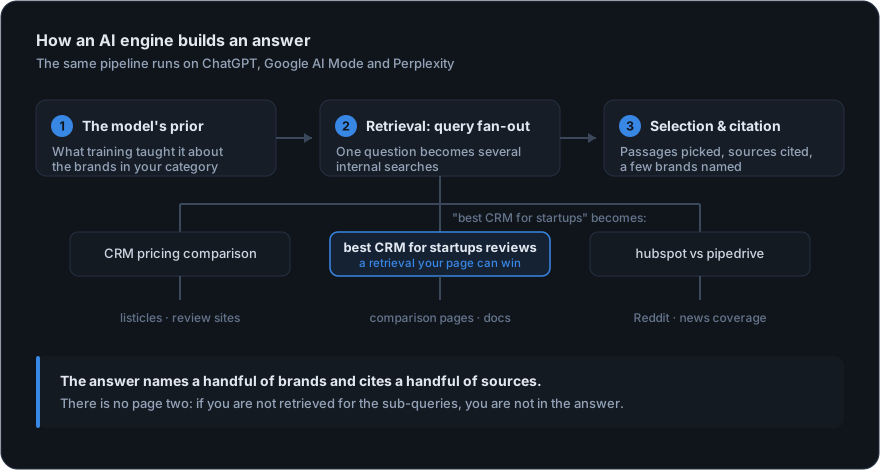
1. The model's prior
Before any search happens, the model already has an opinion: everything it learned in training about which brands belong to your category, from listicles, reviews, forums, documentation, and news. This decides which brands "come to mind" and how they are framed.
2. Retrieval and query fan-out
For commercial and current questions, engines search the web before answering. They rarely search the user's literal words. Instead they decompose the prompt into several internal searches, a step called query fan-out. "Best CRM for startups" might become a pricing comparison search, a reviews search, and two competitor-versus-competitor searches. Each one pulls its own sources, and each is a retrieval you can win or lose.
The engines document this themselves. Google says AI Mode works by "breaking down your question into subtopics and issuing a multitude of queries simultaneously on your behalf", or in a Googler's plainer words, "basically doing a dozen searches for you in the time it takes to do one". OpenAI's help center says ChatGPT search "typically rewrites your query into one or more targeted queries" before sending them to its search providers. Optimizing for one literal keyword misses most of the retrievals that decide the answer.
3. Selection and citation
From the retrieved candidates, the model selects passages that cleanly answer the question and cites the sources it leaned on. Pages that read like self-contained answers beat pages that bury the point.
What the citation data shows
We analyzed 2.1 million sources cited by AI engines across 1,280 brand-tracking projects. The headline findings reshape most people's assumptions:
| Finding | Number |
|---|---|
| Citations from domains outside the top 100 most-cited domains | 73.5% |
| Most-cited single domain | Reddit, about 3x the runner-up |
| Citations pointing at brand-owned (corporate) content | 60.6% |
| Domains that appear only once in the dataset | 63% |
| Datable cited sources published in the last 18 months | 67% |
The long tail dominates. AI engines do not default to a short list of authority domains; they hunt for the best specific answer to each specific sub-question. That is structurally good news for smaller brands: you do not need to out-authority Wikipedia, you need to be the best answer in your niche. The citation mix also differs from engine to engine, which is why per-engine tracking matters more than a single blended score.
The market forcing the change
The behavioral shift is measured, not hypothetical. SparkToro and Datos' clickstream study found 58.5% of U.S. Google searches in 2024 ended without any click to the open web, and their 2026 follow-up puts click-throughs below one third of searches. Meanwhile OpenAI announced more than 900 million weekly ChatGPT users in early 2026, and Semrush's clickstream analysis of 80M+ records saw the number of unique domains receiving ChatGPT referral traffic grow ~300% in the second half of 2024. Buyers are asking assistants, and the assistants answer with brand names.
The three engines that matter
GEO is usually practiced across three engines, and each behaves differently enough to deserve its own line in your reporting:
- ChatGPT leans on the model's prior plus web search for commercial prompts, and often names brands in the answer body without a link. Its crawlers (OAI-SearchBot for search, ChatGPT-User for live fetches) must be able to reach your site for you to enter the retrieval pool.
- Google AI Mode is built on Google's own index and uses query fan-out as its core mechanism: by Google's description, it breaks a question into subtopics and runs multiple searches before synthesizing. Classic Google crawlability and ranking work directly feed it, which a Google AI Mode visibility tracker makes visible prompt by prompt.
- Perplexity searches the live web on every query and pins linked citations next to its answers more aggressively than the other two, which makes citation-rate tracking with a Perplexity visibility tracker especially informative there.
Same discipline, three different scoreboards. A brand can lead on one engine and be missing from another, and the fixes rarely transfer one-to-one.
The GEO workflow: measure, diagnose, fix, verify
GEO programs that work run as a loop, not a launch. Here is the loop.
Step 1: Measure
Track a fixed set of real buyer prompts across ChatGPT, Google AI Mode, and Perplexity, sampled daily to smooth out the randomness. Record whether you are mentioned, in what position, with what sentiment, and against which competitors. This is the job of AI visibility monitoring; for OpenAI specifically, a dedicated ChatGPT visibility tracker adds the engine-level detail.
Without a baseline, every GEO decision is a guess. Measurement comes first because it converts an invisible channel into numbers you can manage.
Step 2: Diagnose
Once you can see where you appear and where you do not, dig into why. Two datasets do most of the diagnostic work:
- The fan-out queries. Query fan-out capture shows the actual searches engines run for your prompts. If a recurring sub-query surfaces only competitor content, you have found a gap with an address.
- The citations. AI citation tracking shows which pages and domains the engines relied on for each answer. These are the exact listicles, review sites, and articles deciding your category.
Step 3: Fix
The diagnosis tells you which of the classic GEO levers to pull first: publish answer-shaped pages for uncovered fan-out queries, earn placement in the third-party sources the engines keep citing, tighten your entity signals, or open the door to AI crawlers that are being blocked. Tactics are covered in detail below.
Step 4: Verify
Because AI answers are probabilistic, verification means watching the trend, not the screenshot. After a fix ships, mention rate and citation rate for the affected prompts should move over the following weeks of daily samples. If they do not, the diagnosis was wrong; go back to step 2. The loop is the strategy. Teams that run it weekly compound; teams that audit once a year stay blind between audits.
How to measure GEO
The KPI set mirrors classic SEO, translated to answers:
| Metric | What it tells you |
|---|---|
| Visibility (mention rate) | Share of tracked prompts where your brand appears. Your headline number: check yours with the free AI visibility score. |
| Share of voice | Your mentions as a share of all brand mentions for the topic. The competitive view. |
| Position | Whether you are the first recommendation or an afterthought. |
| Citation rate | How often your own pages are used as sources. The content-performance view. |
| Sentiment | How the engines frame you when they do mention you. |
| AI referral traffic | Downstream visits from chatgpt.com, Perplexity, and AI Mode to your site, measured on-site with an AI tracker. |
Track them per engine, not blended: a brand can dominate Perplexity and be absent from ChatGPT, and the fixes differ. For how these roll up into revenue reporting, see measuring AI search visibility with revenue KPIs.
GEO tactics that actually work
The measurement loop tells you where to act. These are the levers that consistently move the numbers:
- Let AI crawlers in. One legacy
Disallowrule can erase you from answers. Verify OAI-SearchBot, PerplexityBot, and Google's crawlers can reach you; the free AI crawlability checker tests this in seconds. - Publish answer-shaped content. One page per recurring buyer question and fan-out sub-query: the direct answer in the first paragraph, question-form headings, tables where a table is the honest format.
- Win the retrieved sources. Get into the specific listicles, review platforms, and comparison articles your citation data shows the engines reading. This is the highest-leverage work in most programs.
- Fix your entity. One consistent description and category label everywhere, Organization and Product schema, current third-party profiles. Models hedge on brands they cannot pin down.
- Show up in communities honestly. Reddit is the most-cited single domain in our dataset. Genuine founder and customer presence compounds; astroturfing gets discounted.
- Keep content fresh. Two-thirds of datable cited sources are under 18 months old. Update your key pages and keep third-party coverage current.
What does not work: keyword stuffing aimed at the model, sockpuppet advocacy, and decisions made from a single screenshot of a non-deterministic system.
Honest answers to common questions
Is GEO replacing SEO?
No. SEO still drives traffic to the properties you own, and AI engines retrieve from search indexes, so a crawlable, authoritative site remains the foundation. GEO is an additional layer that manages how you appear inside AI answers, and the two disciplines share most of their groundwork.
Is generative engine optimization a thing?
Yes, though the name is still contested: you will also hear AEO, AI SEO, and LLM SEO for the same work. The practice is real and measurable: AI engines mention and cite brands in patterns you can track daily, and those patterns respond to changes in your content and citation footprint.
Is SEO going away with AI?
SEO is changing, not disappearing. Classic clicks are being partially replaced by zero-click AI answers, which shifts value from rankings toward mentions and citations. The skills transfer: teams that understand crawling, content, and authority adapt to GEO fastest.
What is the difference between GEO and AEO?
In practice, very little: both aim to make your brand the answer rather than a link, and most teams use the terms interchangeably. Where a distinction is drawn, AEO tends to mean structuring content for answer boxes and snippets, while GEO covers the broader work of influencing generative AI answers, including citations and brand mentions beyond your own pages.
How to get started
Start by finding out where you stand. Run the free AI visibility audit to see how AI engines answer your buyers' questions today, or check your AI visibility score in a couple of minutes. When you are ready for a guided walkthrough of your results, book a free audit with the team.
For the full manual process, this guide to running an AI visibility audit walks through every step, and our AI search optimization best practices cover the program-level fundamentals.
Geonimo is the platform built for this loop: it monitors your brand daily across ChatGPT, Google AI Mode, and Perplexity, captures the fan-out queries and citations behind every answer, and turns AI results into visibility metrics you can act on.