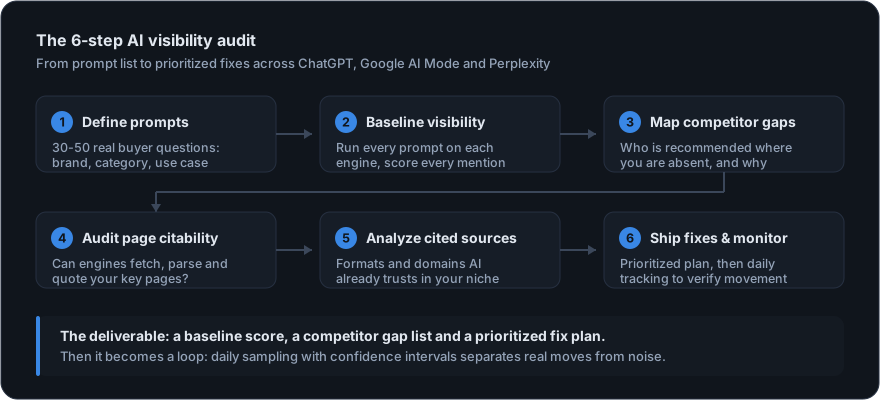
An AI visibility audit answers one question: when AI engines answer your buyers' questions, does your brand show up? The process takes six steps: define the prompts that should trigger your brand, baseline your visibility across ChatGPT, Google AI Mode, and Perplexity, map the gaps where competitors appear instead of you, audit your pages for citability, analyze the sources AI already trusts, and turn it all into a prioritized action plan. This guide walks through each step with the scorecard and deliverables checklist you need.
Why AI Visibility Audits Matter Now
When someone asks ChatGPT "What's the best project management tool for remote teams?" or Perplexity "Which CRM works best for small businesses?": your brand either gets mentioned, or it doesn't.
This is a binary outcome. There's no "page 2" in AI search. The model either includes you in its response, or you're invisible. An AI visibility audit tells you exactly where you stand: which prompts mention you, which mention your competitors instead, and what you need to change to get cited.
If you've done SEO audits before, the process will feel familiar. But the inputs and outputs are fundamentally different. You're not checking meta tags and backlinks. You're checking whether AI models consider your brand worth recommending.
If you want a fast starting point before working through the full process, try the free AI visibility audit.
The 6-Step AI Visibility Audit
Audit Overview
- Define your prompt universe. What questions should trigger your brand?
- Baseline your visibility. Query AI models and record who gets mentioned
- Map your competitors, Who appears where you don't?
- Audit your pages for citability. Can AI actually parse and quote your content?
- Analyze the sources AI prefers. What content format and structure gets cited?
- Build your action plan. Prioritize fixes by impact
Step 1: Define Your Prompt Universe
The foundation of any AI visibility audit is the set of prompts you test against. These are the questions real users ask AI models that should trigger a mention of your brand.
A good prompt universe has three layers:
Layer 1: Brand prompts (5-10)
Direct questions about your brand. You should appear in 100% of these.
"What is [Brand]?"
"Is [Brand] legit?"
"[Brand] reviews"
"[Brand] pricing"
Layer 2: Category prompts (15-25)
Questions about your category where you should be one of several recommendations.
"Best [category] tools in 2026"
"What [category] software do experts recommend?"
"Top [category] solutions for [use case]"
"How to choose a [category] platform"
Layer 3: Problem/use-case prompts (10-20)
Questions about problems your product solves. Highest volume, hardest to win.
"How do I [solve problem your product addresses]?"
"What's the best way to [task your product helps with]?"
"I need to [outcome]: what should I use?"
Start with 30-50 prompts. You can expand later, but this gives you enough coverage to see patterns. The goal isn't to test every possible query: it's to find the ones where you should appear but don't.
If you're using Geonimo, the onboarding process generates prompt suggestions automatically based on your website and industry. You can also add custom prompts at any time.
Step 2: Baseline Your Visibility
Now run each prompt across the major AI platforms and record the results. Start with the three engines where buyer questions concentrate (the same three Geonimo measures daily):
| Platform | Why it matters |
|---|---|
| ChatGPT | Largest user base of any AI assistant. Web search built in. |
| Google AI Mode | Google's conversational search surface. Pulls from the live index. |
| Perplexity | Search-first AI. Cites sources on nearly every answer. |
You can extend the same manual process to other assistants like Claude or Gemini, but these three give you the clearest baseline to start from.
For each prompt, record:
- Mentioned or not. Does your brand appear in the response?
- Position. Are you mentioned 1st, 2nd, 3rd, or later?
- Sentiment. Is the mention positive, neutral, or negative?
- Context. What did the AI say about you? Quote the exact text.
- Competitors mentioned, Who else appears in the same response?
- Sources cited. What URLs did the AI reference?
Doing this manually for 40 prompts across 3 engines means 120 queries. That's most of a working day. And one pass isn't really enough: AI answers vary between runs, so a single measurement can swing your score by several points in either direction. Run each prompt at least twice before you trust the baseline, which doubles the workload again. This is where automation tools like Geonimo save significant time: the platform runs all prompts daily across ChatGPT, Google AI Mode, and Perplexity and extracts this data automatically. See the dedicated pages for each engine: ChatGPT visibility tracker, Perplexity visibility tracker, and Google AI Mode visibility tracker.
Your baseline should give you a single number: your AI visibility score. The simplest formula: (number of prompts where you're mentioned / total prompts) x 100. If you appear in 15 out of 40 prompts, your visibility score is 37.5%. Because of run-to-run variance, treat that number as an estimate, not a fact: Geonimo reports visibility with a 95% confidence interval and labels changes that fall inside it as "ns" (not significant), and your manual audit should carry the same humility.
Step 3: Map Your Competitors
The AI visibility audit becomes strategic when you see who appears instead of you. For every prompt where your brand is absent, record which competitors are mentioned.
You're looking for three patterns:
- Content gaps. Prompts where competitors appear but you don't. This means AI has found content from them that answers the question, but nothing equivalent from you. These are your highest-priority content opportunities.
- Position gaps. Prompts where you both appear, but a competitor is mentioned first. First position in an AI response carries disproportionate weight: users often act on the first recommendation.
- Sentiment gaps. Prompts where you're mentioned but with caveats or negative framing, while competitors get clean positive mentions. This often signals a reputation issue on UGC platforms like Reddit.
Track 3-5 direct competitors. More than that creates noise without adding insight. Focus on the competitors that appear most frequently across your prompt universe: they're the ones AI models consider your true alternatives. If you want the competitive picture as one number, compute AI share of voice: your mentions divided by all brand mentions across your prompt set. Geonimo's competitor tracking suggests competitors automatically from your answer data and scores them side by side.
Step 4: Audit Your Pages for AI Citability
This is where an AI visibility audit differs most from a traditional SEO audit. You're not checking whether Google can crawl your pages. You're checking whether AI models can extract quotable, authoritative content from them.
For each key page on your site (homepage, product pages, pricing, key blog posts), evaluate these six dimensions:
Page Citability Scorecard
| Dimension | Weight | Question |
|---|---|---|
| AI Citability | 20% | Does the page contain quotable definitions, direct answers, stats, or FAQ content that AI can safely extract? |
| Authority & Trust | 15% | Are there author attributions, company credentials, testimonials, published dates, and external citations? |
| AI Readability | 15% | Is the content in semantic HTML with clear heading hierarchy, JSON-LD structured data, and Open Graph tags? |
| Technical SEO | 20% | Are title tags, meta descriptions, canonical URLs, and mobile viewport properly configured? |
| Content Quality | 15% | Is the content substantive (600+ words), topically deep, and offering original insights rather than generic claims? |
| On-Page SEO | 15% | Are primary keywords in the H1, title, meta description, and first 100 words? Are there internal links? |
Score each dimension 0-100. A page that scores below 50 on AI Citability is essentially invisible to AI models, even if it ranks well on Google.
Start with the technical layer, because it's binary: the free AI crawlability checker tests whether AI crawlers like GPTBot and PerplexityBot can actually fetch your pages and whether you serve an llms.txt file (the llms.txt generator creates one if you don't).
For the rest, you can run this audit manually by reviewing each page against the criteria above and scoring each dimension in a simple spreadsheet. Or book the free audit and the Geonimo team runs the baseline for you.
Step 5: Analyze the Sources AI Prefers
Look at the sources (URLs) that AI models cite in their responses. This tells you what content format and structure AI currently trusts for your category.
Based on our analysis of 2.1 million AI-cited sources, here's what to look for:
- Source types. Is AI citing corporate pages, blog posts, Reddit discussions, or news articles for your category? Corporate pages account for 60.6% of all citations, but the mix varies by industry.
- Domain patterns, Which specific domains appear most? If AI cites a competitor's blog post but not yours, the blog post format clearly works for this query.
- Content recency. Are the cited sources recent (last 12 months) or evergreen? For most competitive queries, freshness is a strong signal.
- Content structure. Do the cited pages have FAQs, comparison tables, numbered lists, or long-form explanations? Mirror the structure that works.
The goal is to reverse-engineer what AI considers a "good source" for your specific category. Then make sure your content matches that pattern.
Step 6: Build Your Action Plan
An audit without an action plan is just a report. Prioritize your fixes by impact:
- CRITICAL. Fix citability blockers: Pages that AI literally can't read: JavaScript-rendered content without SSR, missing structured data, no meta descriptions. These are binary: fix them and you go from invisible to visible.
- HIGH. Fill content gaps: Create content for prompts where competitors appear but you don't. Focus on the prompts with the highest commercial intent first. Each piece should directly answer the question the prompt asks.
- MEDIUM. Improve existing pages: Add FAQ sections, quotable definitions, statistics, and comparison tables to pages that exist but don't get cited. Make the content easy for AI to extract and quote.
- ONGOING. Monitor and iterate: AI models update constantly. Run your prompt universe weekly or daily to track changes. Set up alerts for visibility drops. This is not a one-time audit: it's a continuous process. Close the loop on your own site too: Geonimo's AI Tracker, the AI traffic analytics side of the platform, detects AI bot crawls and AI referrals, so you can verify that rising visibility actually turns into visits.
Audit Deliverables Checklist
Whether you're running this audit for your own brand or presenting it to a client, here's what the final deliverable should include:
- AI visibility score (% of prompts where brand is mentioned, with a confidence interval)
- Visibility by platform (ChatGPT vs Google AI Mode vs Perplexity)
- Competitor comparison (visibility scores side-by-side)
- Content gap list (prompts where competitors appear but brand doesn't)
- Citation list (verified citations only: pages that are cited and actually name the brand)
- Page citability scores (top 10-20 pages scored across 6 dimensions)
- Source analysis (what domains and content types AI prefers in this category)
- AI traffic baseline (AI bot crawls and AI referrals detected on the site)
- Prioritized action plan (Critical / High / Medium / Ongoing fixes)
- Baseline metrics for ongoing tracking
Manual vs Automated Audits
You can run an AI visibility audit entirely manually. Open ChatGPT, Google AI Mode, and Perplexity, type in your prompts, and record the results in a spreadsheet. It works. It takes most of a day for 40 prompts across 3 engines (120 queries, more if you run each prompt twice for a stable baseline), and you'll need to redo it regularly since AI responses change.
The case for automation is simple: scale and consistency. A tool like Geonimo runs your entire prompt universe daily across ChatGPT, Google AI Mode, and Perplexity, extracts mentions automatically, and tracks changes over time. What takes a day manually runs continuously once your tracking is set up.
For agencies, the math is even clearer. Running audits for 10 clients with 40 prompts each means 400 prompts, or 1,200 individual checks across the three engines, per pass. Doing that monthly by hand isn't practical; doing it daily is impossible. Automation turns it into a scalable service, and white-label reports turn the results into client deliverables.
What a Good Audit Score Looks Like
After auditing hundreds of brands on our platform, here are the benchmarks we see:
| Score | Rating | What it means |
|---|---|---|
| 80%+ | Excellent | Brand appears in most relevant AI responses. Typically category leaders with strong content programs. |
| 50-79% | Good | Visible for core brand queries, gaps in category and problem queries. Room to grow with targeted content. |
| 20-49% | Weak | Missing from most category conversations. Competitors are being recommended instead. Significant content gaps. |
| 0-19% | Invisible | AI models don't know your brand exists for most queries. Usually indicates fundamental citability issues (JS-rendered pages, no structured data, thin content). |
Most brands running their first audit land between 20-40%. That's not a failure: it's a baseline. The goal is to identify the specific gaps and close them systematically.
Start Your Audit
An AI visibility audit is the first step to understanding whether your brand is part of the conversation when AI recommends solutions. The process is straightforward: define your prompts, measure your baseline, identify gaps, fix your pages, and monitor continuously.
You can start manually today: pick 10 prompts, run them across ChatGPT and Perplexity, and see where you stand. Check your free AI visibility score for an instant read, or book a free audit and get your first insights within 24 hours.
Related Articles