TL;DR. What This Guide Covers
- Clients have started asking "do we show up in ChatGPT?" and most agencies cannot answer with data yet. GEO reporting is the retention play of 2026.
- GEO metrics are fundamentally different from SEO metrics. Brand Visibility, Share of Voice in AI, and Citation Rate replace rankings and CTR.
- A proper monthly GEO report has 9 sections, from executive summary to platform breakdown to AI traffic impact.
- Each AI engine retrieves and cites differently. A brand can be strong on one engine and absent from another, so platform-specific reporting is essential.
- Brand-owned content earns 60.6% of AI citations (Geonimo analysis of 2.1M cited sources): the stat that turns skeptical clients into GEO believers, because the biggest lever is the site they already control.
- The reporting bar is still low. The agency that shows up with trended, per-engine data wins the retainer; the one with a blank stare loses it.
| 2.1M | 60.6% | 73.5% | 67% |
|---|---|---|---|
| AI-cited sources we analyzed | of AI citations are brand-owned content | of citations from outside the top 100 domains | of datable cited sources under 18 months old |
1. The Reporting Gap
Your clients are starting to ask a question you probably can't answer yet: "Do we appear when someone asks ChatGPT about our category?"
The demand side has arrived: GEO is on the 2026 planning agenda of most marketing teams we talk to. The supply side is lagging badly. Most agencies have no GEO reporting infrastructure at all, no tracked prompts, no baseline, no trend lines.
Key Finding: In our experience running AI visibility audits, a striking number of brands don't appear in AI answers at all for their core category prompts. Most of them don't know it, because nobody is measuring it.
This is the gap. When a CMO asks their agency "Are we visible in AI search?" and the answer is a blank stare or a vague "we're looking into it," that's a retention risk. Agencies that can answer this question with data will win retainers. The ones that can't will lose them to agencies that can.
The good news: the bar is still low. Most agencies aren't doing this yet. If you build a GEO reporting practice in 2026, you're ahead of the pack.
The agency opportunity: GEO reporting isn't just a new deliverable, it's a new revenue stream. Clients will pay for the visibility measurement, the monitoring, and the optimization. This is a three-layer upsell on top of existing SEO retainers.
2. GEO Metrics vs SEO Metrics
The first mistake agencies make is trying to force-fit SEO metrics into a GEO report. GEO has its own KPIs, and clients need to understand the difference. Here's a direct translation table from the metrics your clients already know to the GEO equivalents they need to start tracking.
| SEO Metric | GEO Equivalent |
|---|---|
| Keyword rankings | Brand Visibility (% of AI answers mentioning brand) |
| Organic traffic | AI referral traffic + branded search lift |
| Click-through rate (CTR) | Citation Rate |
| Market share | Share of Voice in AI |
| Sentiment monitoring | AI Sentiment Score (-1 to +1) |
| Featured snippets | Mention Position (1st, 2nd, 3rd) |
| Backlinks | Citation quality + third-party mentions |
The critical shift here is from click-based metrics to mention-based metrics. In SEO, the ultimate goal is a click. In GEO, the brand might never receive a click, but if it's mentioned favorably in an AI answer, that's still a conversion driver. Your reporting needs to capture both direct traffic impact and the brand influence that happens inside the AI response.
Key Finding: The core GEO KPIs every agency report should include: Brand Visibility Score, Share of Voice vs competitors, Citation Rate per platform, Mention Position, AI Sentiment Score, and AI Referral Traffic. The full formulas are in our AI search visibility KPI guide.
3. The Monthly GEO Report Structure
After working with agencies running GEO campaigns, we've identified 9 sections that make up a complete monthly GEO report. This isn't aspirational: this is what clients are starting to expect when they pay for AI visibility monitoring.
The 9-section monthly GEO report
- Executive Summary. One-page overview: overall visibility trend, biggest wins, biggest risks, and the 3 recommended actions for next month. Clients read this. Everything else is supporting evidence.
- AI Visibility Scorecard. The dashboard view. Brand Visibility Score (0-100), Citation Rate, Share of Voice vs top 3 competitors, average Mention Position, and AI Sentiment Score. All trended month-over-month.
- Platform Breakdown. Performance split per engine: ChatGPT, Google AI Mode, and Perplexity are the answer engines worth a weekly tracking series today, with referral traffic from the wider set (Claude, Gemini, Copilot, and others) covered in the traffic section. Each platform has different behaviors: your client needs to see where they're winning and losing per platform.
- Prompt-Level Performance. Top-performing prompts (highest visibility), worst-performing prompts (content gaps), and new prompt opportunities. This is where you show which specific questions trigger brand mentions.
- Citation & Source Analysis, Which sources are driving brand mentions. Breakdown by source type (corporate, editorial, UGC, review). Identify which third-party pages mention the brand and whether those pages are being cited by AI.
- Competitor Analysis. Share of Voice comparison. Where competitors are mentioned and your client isn't. Content gaps and competitive positioning. The section that drives the most client conversation.
- AI Traffic & Business Impact. AI referral traffic from analytics, ideally captured server-side with an AI traffic tracker so bot crawls and adblocked visits aren't lost. Conversion rate comparison between AI traffic and organic search: AI referral volume is usually small, but those visitors arrive pre-sold by a recommendation, and clients need to see what that traffic is worth. Branded search lift correlated with AI mention frequency. The section that justifies the budget.
- GEO vs SEO Side-by-Side. How AI visibility compares to traditional SEO performance. Are they aligned or divergent? Pages that rank well on Google but are invisible to AI (and vice versa). Helps clients understand the two channels are distinct.
- Actions & Recommendations. Specific, prioritized actions for the next 30 days. Content updates, schema additions, third-party outreach targets, and prompt-specific optimization recommendations. This is where the retainer earns its keep.
Pro tip: Don't send all 9 sections to every stakeholder. CMOs get sections 1, 2, and 7. Marketing managers get sections 3-6. Content teams get sections 4, 5, and 9. Customize the deliverable by audience.
4. Platform Differences Matter
One of the biggest mistakes in GEO reporting is treating "AI search" as a single channel. It's not. Each AI platform has fundamentally different retrieval behaviors, source preferences, and citation patterns. Reporting on "AI visibility" as a single number is like reporting on "search engine rankings" without specifying whether you mean Google, Bing, or Yahoo.
Key Finding: A brand can be highly visible on one platform and completely absent on another. In the audits we run, the per-engine gap is routinely the most surprising slide in the deck. Your report needs platform-level granularity, or it's hiding critical blind spots.
- ChatGPT: The largest AI assistant audience, and the hardest platform to break into. It cites relatively few sources per response and leans on entrenched brand priors, so wins here come slowly and compound. Highest impact when you land. Track it with the ChatGPT visibility tracker.
- Perplexity: The most citation-transparent engine: every answer ships with numbered sources, and it favors freshness and community content. In our 2.1M-source dataset, Reddit is the single most-cited domain, by a factor of 3x over the runner-up, and Perplexity's retrieval style is a big reason why. Usually the fastest platform to show movement on. The Perplexity visibility tracker covers it.
- Google AI Mode: Built on Google's index with query fan-out, so classic SEO carries over most directly here. The most predictable platform, but the hardest to influence independently of the client's existing rankings. Measured via the Google AI Mode visibility tracker.
Clients will also ask about Claude, Gemini, and AI Overviews. Handle them honestly in the report: referral traffic and crawler activity from those platforms is measurable in site analytics today, while answer-level tracking for them belongs on the roadmap slide, not the scorecard.
What to include in the platform section: Per-platform Visibility Score, mention count, citation rate, and top-cited sources. Highlight any platform where the brand is significantly underperforming relative to competitors. Call out platform-specific opportunities.
5. The Volatility Problem
If there's one thing you need to educate your clients on, it's this: AI visibility is volatile in ways that SEO never was. AI answers are non-deterministic: the same prompt returns different brands and different citations run to run, and a brand's visibility can swing from week to week without any changes to their content.
Key Finding: A one-time measurement is close to meaningless. Because consecutive runs of the same prompt routinely produce different answers, you need daily tracking over 30+ days to establish a reliable baseline and separate signal from noise.
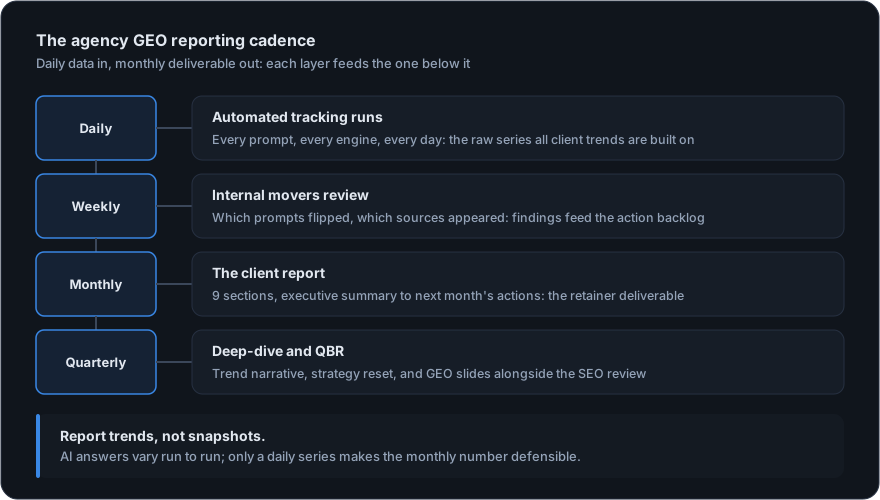
This has a direct implication for how you report. Report trends, not snapshots. A single visibility check on the day you run the report tells the client almost nothing. What matters is the 30-day trend: is the brand's visibility trending up, down, or stable? Are the fluctuations narrowing (stabilizing) or widening (deteriorating)?
Visibility can deteriorate fast when engines refresh their sources or ship a model update: we regularly see brands lose ground over a few weeks with no change to their own content. Without continuous monitoring, brands and agencies wouldn't even know it was happening until the next quarterly review.
How to present volatility to clients: Use 30-day rolling averages instead of point-in-time measurements. Show confidence bands or min/max ranges. Frame volatility as the reason continuous monitoring is essential, not a flaw in the data.
6. How to Sell GEO Reporting to Clients
Knowing how to build the report is half the battle. The other half is getting clients to pay for it. Here's the pricing structure and sales approach that's working for agencies in 2026.
Three Service Tiers
| Tier | Price | Description |
|---|---|---|
| GEO Audit | $5K-10K (one-time) | Comprehensive baseline assessment. AI visibility scorecard, platform breakdown, competitor benchmarking, and a prioritized list of optimizations. Delivered as a one-time report with recommendations. Perfect as a foot-in-the-door offer. |
| GEO Monitoring Retainer | $1.5K-3K/mo (on top of SEO) | Monthly GEO report (the 9-section structure above), continuous visibility tracking, quarterly deep-dives, and monthly optimization recommendations. The recurring revenue play. Add to existing SEO retainers. |
| Enterprise GEO Strategy | Custom pricing | Full-service GEO optimization: content creation, schema implementation, third-party citation building, AI traffic analytics, and executive reporting. Multi-brand and multi-market support. For clients with $10K+/month budgets. |
The Sales Approach
The most effective way to sell GEO is to lead with a free AI Brand Visibility audit. Run a quick check across ChatGPT, Google AI Mode, and Perplexity for 5-10 of the client's core prompts. Show them where they appear, and more importantly, where they don't. The gap between perception and reality is usually enough to close the deal.
The pitch in one line: "Your customers are asking AI, not Google. Right now, you don't know if you appear in those answers. We can show you, and fix it."
Beyond the standalone pitch, add 2 GEO slides to every QBR (quarterly business review). Show the AI Visibility Score and Share of Voice alongside your SEO metrics. Even if the client hasn't bought GEO services yet, this plants the seed and positions you as the agency that's thinking ahead.
7. The Data That Changes the Conversation
When you're pitching GEO to a skeptical client (or justifying the budget to a CFO) you need data that's impossible to ignore. These numbers come from our own analysis of 2.1 million sources cited by AI search engines, so you can cite them with a straight face.
Stats That Close Deals
| Stat | What it means |
|---|---|
| 60.6% | of AI citations go to brand-owned corporate content. The client's own website is their biggest GEO asset, and most haven't structured it for AI at all. |
| 73.5% | of citations come from domains outside the top 100. Clients don't need Forbes-level authority: they need to be the best answer to specific questions in their niche. |
| 4.9% to 20.6% | UGC's share of AI citations over five months. What people say about the client on Reddit and YouTube is now part of their visibility footprint. |
| 6.1x | growth in citation volume extracted in our dataset over five months. The channel is compounding while most brands aren't even measuring it. |
| 67% | of datable cited sources were published in the last 18 months. A content refresh cadence is one of the highest-ROI GEO deliverables an agency can sell. |
| 63% | of the 567K cited domains appear only once in the dataset. AI models actively hunt for niche, specific sources, which is exactly where smaller clients can win. |
The most powerful stat in this list is the 60.6% corporate content share. It reframes the conversation from "do we need a PR army to win AI visibility?" to "the content we already control decides most of it, we just have to structure it properly." That turns GEO from an intimidating new channel into an executable retainer.
"SEO is built around earning visibility that converts into clicks. AI search supplies information that can be extracted, trusted, and reused without a click."
Mike King, iPullRank
8. Common Mistakes in GEO Reporting
The GEO reporting space is new enough that there's no established playbook. That means agencies are making predictable mistakes. Here are the five most common, and how to avoid them.
- Treating GEO as a one-time audit instead of ongoing monitoring. Given how much answers vary run to run, a one-time snapshot is nearly useless. Clients need monthly reporting at minimum, with daily tracking running in the background. The one-time audit is a sales tool: the retainer is the real service.
- Only optimizing blog content and ignoring service/comparison pages. Agencies default to optimizing blog posts because that's the SEO muscle memory. But AI models frequently cite service pages, pricing pages, comparison pages, and FAQ pages. Your GEO strategy needs to cover the full site, not just the blog.
- Hiding behind "proprietary algorithms" instead of concrete recommendations. Clients are paying for actionable insights, not mystery. If your recommendation is 'we ran it through our AI optimization engine,' that's a red flag. GEO recommendations should be specific: add FAQ schema to these 5 pages, update these 3 outdated statistics, build citations on these 2 platforms.
- Reporting vanity metrics disconnected from business impact. A visibility score means nothing if you can't connect it to business outcomes. Always tie GEO metrics to AI referral traffic, conversion rates, and branded search lift. Section 7 of the report structure (AI Traffic & Business Impact) exists specifically to solve this.
- Overselling: repackaging standard SEO as "AI SEO". Some agencies are slapping an 'AI-optimized' label on standard SEO work and calling it GEO. Clients will figure this out. GEO has genuinely different tactics (structured data optimization, third-party citation building, prompt-level performance tracking) that don't exist in traditional SEO. If your GEO offering is just regular SEO with a new name, it won't survive scrutiny.
The credibility test: Can you show a client their AI Visibility Score for a specific prompt, on a specific platform, trended over 30 days? If yes, you have a real GEO practice. If not, you have a presentation deck.
9. How Geonimo Fits Agency Reporting
A word on where we fit, stated honestly. Geonimo is a done-for-you GEO service with a tracking platform behind it, and for agencies it maps onto the reporting problem at three levels.
- Client-ready reports, built from daily tracking. Our GEO reports cover the core of the 9-section structure above: visibility scorecard, share of voice, citation and source analysis, and competitor breakdowns across ChatGPT, Google AI Mode and Perplexity, built from daily tracking rather than one-off snapshots. A weekly email report ships on every plan. You present them; you don't have to produce them.
- Monthly strategy reviews on Expansion and above. On the Expansion plan ($399/month, or $319/month billed yearly) and up, our team walks through the data with you monthly and agrees the next month's actions, which slots directly into your client QBR rhythm.
- White-label reporting on Scale. On the Scale plan (custom pricing), reporting goes white-label: Geonimo data delivered under your agency's brand, plus weekly team-written reports and a dedicated success manager. That's the setup built for agencies running GEO across a client portfolio.
- Multi-brand workspaces. Each client brand runs in its own workspace with its own prompt set, competitors, and history, so agency data stays cleanly separated per client.
- Done-for-you execution you can resell. The optimization work (content, structure, citation building) is done by our team. Agencies bundle it into their retainers and keep the client relationship; we do the GEO layer underneath.
Pricing starts at $199/month per brand, or $159/month billed yearly (full pricing). There's no trial, but the free audit is the natural first step for any client pitch: we run their brand across ChatGPT, Google AI Mode and Perplexity and you get first insights within 24 hours, which is usually all the sales material a GEO conversation needs. Book a free audit for a client brand.
Build the Practice Now
The window is open right now. GEO reporting demand is arriving faster than agency supply, and the agencies that build the expertise, the reporting infrastructure, and the client education programs first will be the ones that own the retainers when it becomes a standard line item.
The playbook is clear:
- Start with audits. Run free AI visibility checks for your top 5 clients. Show them the gap between where they think they are and where they actually are.
- Build the reporting structure. Use the 9-section framework above. Automate what you can. Manual analysis is fine for the first few clients, but you need tooling to scale.
- Price it as an add-on. $1.5K-3K/month on top of SEO retainers is an easy sell when you show the citation data above and the client's own competitive blind spots.
- Educate your clients. GEO is new to most CMOs. The agency that educates them becomes the trusted partner. The agency that waits becomes the one that gets replaced.
AI search isn't replacing Google: it's adding a new channel where brands need to compete. The transition from "we should look into this" to "we need this in our monthly reporting" is happening right now. The question isn't whether your clients will need GEO reporting. The question is whether they'll get it from you, or from the agency that replaces you.
Related Articles