What is the state of AI search visibility in 2026? Based on 50,000+ AI-generated answers we analyzed: recency and structure now beat raw domain authority, most brand mentions come from pages brands don't own, visibility swings 15-25% week to week, and a small group of brands captures most of the mentions in every category. The six findings below unpack each of those, with the data behind them.
TL;DR: 6 Things We Found
- 73% of AI citations come from pages updated in the last 90 days. Stale content gets dropped.
- Pages with FAQ schema are 3.2x more likely to be cited than pages without structured Q&A.
- Perplexity cites 4x more sources per response than ChatGPT: making it the easiest platform to win.
- 82% of brand mentions in AI come from third-party sources, not the brand's own website.
- AI visibility scores fluctuate 15-25% week-over-week: one-time measurement is meaningless.
- The top 10% of brands capture 68% of all AI mentions in their category.
| 50K+ | 5 | 1,200+ | 18 |
|---|---|---|---|
| AI responses analyzed | AI platforms sampled (2026 dataset) | Brands monitored | Industries covered |
1. Fresh Content Wins. Everything Else Decays.
The single biggest predictor of whether AI will cite a page is how recently it was updated. Pages that haven't been touched in 90+ days see a steep decline in AI citations: regardless of their domain authority or backlink profile.
Key Finding: 73% of all AI citations point to pages updated within the last 90 days. Pages older than 6 months account for just 8% of citations, even when they rank well on Google.
Citation rate by content freshness
| Content age | Citation rate |
|---|---|
| < 30 days | 42% |
| 30-90 days | 31% |
| 90-180 days | 19% |
| > 180 days | 8% |
This doesn't mean you need to rewrite every page monthly. Our data shows that even small updates: adding a new statistic, updating a date, refreshing a paragraph: are enough to signal freshness. AI models appear to weight the last-modified signal heavily.
What to do: Audit your top 20 pages. If any haven't been updated in 90+ days, refresh them, even minor updates count. Add a "Last updated" date visible on the page.
2. Structure Beats Authority. FAQ Schema Is the Single Biggest Lever
We expected domain authority to be the top signal. It wasn't. Content structure: specifically FAQ schema, clear heading hierarchies, and quotable definitions: had a stronger correlation with AI citations than backlink count.
Key Finding: Pages with FAQ schema markup are 3.2x more likely to be cited by AI than equivalent pages without it. Pages with JSON-LD structured data of any type are 2.1x more likely.
Citation likelihood multiplier by page feature
| Page feature | Citation likelihood |
|---|---|
| FAQ schema | 82% |
| HowTo schema | 68% |
| JSON-LD (any) | 54% |
| H1-H3 hierarchy | 47% |
| Numbered lists | 41% |
| Statistics cited | 38% |
| No structured data | 18% |
Why? AI models need to extract a clean, quotable answer. FAQ pages hand them exactly that: a question and a self-contained answer. It's the lowest-friction content for an AI to cite with confidence.
3. Not All AI Engines Are Equal. Platform Differences Are Massive
One of the most surprising findings: the same page can be cited by Perplexity and completely ignored by ChatGPT. Each platform has different retrieval patterns, citation rates, and source preferences.
Average citations per AI response
| Platform | Relative citation volume |
|---|---|
| Perplexity | 87% |
| Google AI | 62% |
| Gemini | 48% |
| Claude | 34% |
| ChatGPT | 22% |
Key Finding: Perplexity cites 4x more sources per response than ChatGPT. If you're only tracking one platform, Perplexity gives you the most surface area. But ChatGPT has 10x the user base: fewer citations, but each one reaches far more people.
- Perplexity. Cites the most sources. Prefers editorial content, Reddit, and review sites. Easiest platform to win citations on. Refreshes results frequently.
- ChatGPT. Fewest citations but largest audience. Prefers authoritative corporate pages and well-known domains. Hardest to break into. GPT-5.3/5.4 reduced citations further.
- Google AI Overviews. Heavily weighted toward pages already ranking in top 10 organic results. If you rank on Google, you'll likely appear in AI Overviews. If you don't, you won't.
- Claude. Moderate citation rate. Shows strong preference for technical documentation, academic sources, and long-form content with clear expertise signals.
(The platform rows above reflect the early-2026 dataset, which sampled five platforms. Geonimo's current pipeline measures ChatGPT, Google AI Mode, and Perplexity daily.)
If ChatGPT is your priority channel, the ChatGPT visibility tracker shows exactly where your brand appears there and where it doesn't. The same landers exist for Perplexity and Google AI Mode.
4. 82% of Brand Mentions Come from Third-Party Sources
Most brands assume that optimizing their own website is enough. Our data shows the opposite: the vast majority of AI brand mentions come from pages you don't control.
Key Finding: 82% of brand mentions in AI responses originate from third-party sources, review sites, Reddit, editorial publications, and competitor comparison pages. Only 18% come from the brand's own domain.
Top source types for brand mentions
| Source type | Share of mentions |
|---|---|
| Review sites | 28% |
| Reddit/UGC | 24% |
| Editorial | 19% |
| Brand's own site | 18% |
| Comparison pages | 11% |
This has major implications. Brands need a dual strategy: optimize their own pages for citability and build presence on the third-party sources AI engines trust. A strong G2 profile, active Reddit presence, and PR coverage in editorial sites directly impact AI visibility. Two features exist for exactly this work: AI sources analysis shows which domains shape AI answers in your category, and PR opportunities surfaces the third-party placements worth pursuing.
5. AI Visibility Is Volatile. Weekly Swings of 15-25% Are Normal
Unlike Google rankings, which shift gradually, AI visibility can swing dramatically from week to week. A brand might be cited in 80% of relevant queries one week and 55% the next, without any changes to their content.
Key Finding: The average brand experiences 15-25% week-over-week fluctuation in AI visibility. This means a single measurement is unreliable. You need daily tracking over at least 30 days to establish a meaningful baseline.
Why this happens: AI models don't always retrieve the same sources. Query interpretation varies slightly between runs, model updates change retrieval behavior, and the competitive landscape shifts as new content gets published. The result is inherent volatility that makes point-in-time measurement unreliable.
This finding shaped how Geonimo reports AI share of voice: prompts are sampled daily, scores are reported with a 95% confidence interval, and any week-over-week move that falls inside the interval is labeled "ns" (not significant). If a tool shows you a visibility score as a single bare number from a single run, this data says that number is mostly noise.
6. Winner Takes Most. The Top 10% Capture 68% of All Mentions
AI search has a severe concentration problem. In every industry we analyzed, a small number of brands dominate the AI conversation while the rest are essentially invisible.
Key Finding: The top 10% of brands in any category capture 68% of all AI mentions. The bottom 50% of brands collectively receive less than 5% of mentions. AI search is winner-takes-most.
Share of AI mentions by brand tier
| Brand tier | Share of mentions |
|---|---|
| Top 10% | 68% |
| 11-25% | 18% |
| 26-50% | 9% |
| Bottom 50% | 5% |
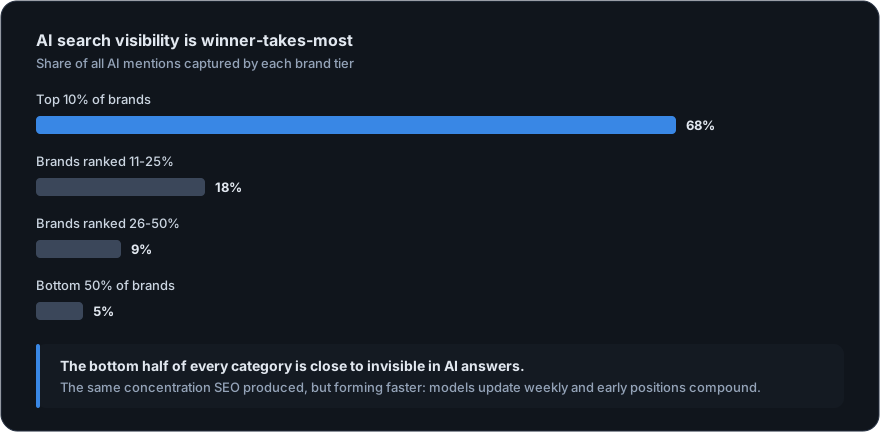
This mirrors what happened with SEO in its early days: the brands that invested first captured dominant positions that became increasingly difficult to challenge. The same dynamic is playing out in AI search, but faster. With AI models updating weekly, the window to establish a strong position is narrowing.
The concentration is at the brand level; the sources behind those mentions are far more fragmented. In our separate analysis of 2.1M AI-cited sources, most citations came from the long tail of domains, which is precisely how challenger brands break into the top tier: by being the best specific answer, not the biggest name.
Industry Context: What Other Datasets Show
Our findings sit inside a broader measured shift. Similarweb measures average monthly visits to generative AI platforms up 70% year over year, reaching 9.5 billion between June 2025 and May 2026, and its ChatGPT panel shows citations appearing in roughly 6.8% of US prompts by May 2026, up from about 1.6% a year earlier. SparkToro/Datos measure fewer than one third of Google searches now sending a click to the open web. And click behavior around AI answers keeps evolving: Seer Interactive's 2026 update shows organic CTR on AI Overview queries recovering through early 2026 after the 2025 decline, while brands cited inside AI answers continue to out-click uncited brands. The consistent throughline: presence inside the answer is the metric that pays.
Methodology
This report is based on analysis of 50,000+ AI-generated responses collected between January and March 2026 with our previous-generation pipeline, which sampled five platforms: ChatGPT (GPT-5), Perplexity, Claude, Google AI Overviews, and Gemini. Responses were collected from 1,200+ brands across 18 industries using standardized prompts designed to trigger product recommendations, comparisons, and informational answers.
Brand mentions were extracted using Geonimo's NLP pipeline with fuzzy matching. Citation sources were classified by domain type (Corporate, Editorial, UGC, Review). Content freshness was determined by crawling cited pages and checking last-modified headers and visible date signals.
The current Geonimo pipeline measures ChatGPT, Google AI Mode, and Perplexity daily. It is also stricter than the pipeline behind this dataset: share of voice is reported with 95% confidence intervals, week-over-week moves inside the interval are labeled "ns" (not significant), and citations are credited only when verified, meaning the cited page actually names the brand. The next edition of this report will be based on that pipeline. Visibility scores, platform breakdowns, and citation rates referenced in this report are aggregated across all tracked brands. Individual brand results will vary.
Want to know where your brand stands today? Check your free AI visibility score or book a free audit with the Geonimo team.
Related Articles