If you take one thing from this guide, take the AI share of voice formula. It is the single most important AI search KPI, and everything else in this framework builds on it:
AI Share of Voice = (Your Brand Mentions / Total Brand Mentions for Your Category) x 100
Run the same set of buyer prompts against AI engines on a schedule, count every brand mention in the answers, and divide yours by the total. That one number tells you whether AI recommends you or your competitors. The rest of this guide covers how to measure it properly, and how to connect it to traffic and revenue.
Why Measuring AI Search Visibility Is Hard
Let's start with an uncomfortable truth: most companies have no idea whether their AI search efforts are working. They know they're being mentioned by ChatGPT sometimes. They think Perplexity has cited them once or twice. But they can't tell you how often, in what context, or whether any of it led to a single dollar of revenue.
This isn't their fault. Traditional analytics tools were built for a world where every visitor came through a clickable link with a trackable referrer. AI search broke that model. When ChatGPT recommends your brand in a conversation, there's no click, no referral header, no UTM parameter. The user might visit your site hours later through a direct search - and your analytics will credit it to "organic" or "direct."
Three things make this hard to ignore:
- A large share of AI-influenced visits land in your analytics as "direct" or "organic", with no trace of the AI conversation that caused them
- AI assistants answer buyer questions at enormous scale, before those buyers ever reach a search results page
- Most marketing teams still have no framework for measuring any of it, so the channel grows while the reporting stays blank
So how do you actually measure this? You need a framework built specifically for how AI search works - not a retro-fitted version of your SEO dashboard.
What Independent Data Says About AI Traffic Value
Before the framework, the external evidence that AI-referred visitors deserve their own measurement:
- Semrush's traffic study found the average AI search visitor is 4.4x as valuable as the average organic search visit, based on conversion rate.
- Seer Interactive measured that brands cited inside a Google AI Overview see 35% more organic clicks and 91% more paid clicks than uncited brands on the same queries.
- Adobe Analytics (1+ trillion U.S. retail site visits) found AI-referred visitors show 8% higher engagement, browse 12% more pages per visit, and bounce 23% less than non-AI traffic.
Low session counts with high value per session is exactly the profile that gets ignored by teams measuring raw traffic. That is the case for the framework below.
The AI Visibility Measurement Framework
We break AI search measurement into three layers. Each builds on the previous one, moving from awareness to action to revenue:
The Three Layers:
- Visibility KPIs - Are you being mentioned? How often? Where?
- Engagement KPIs - Is that visibility driving traffic and interaction?
- Revenue KPIs - Is any of it converting into actual money?
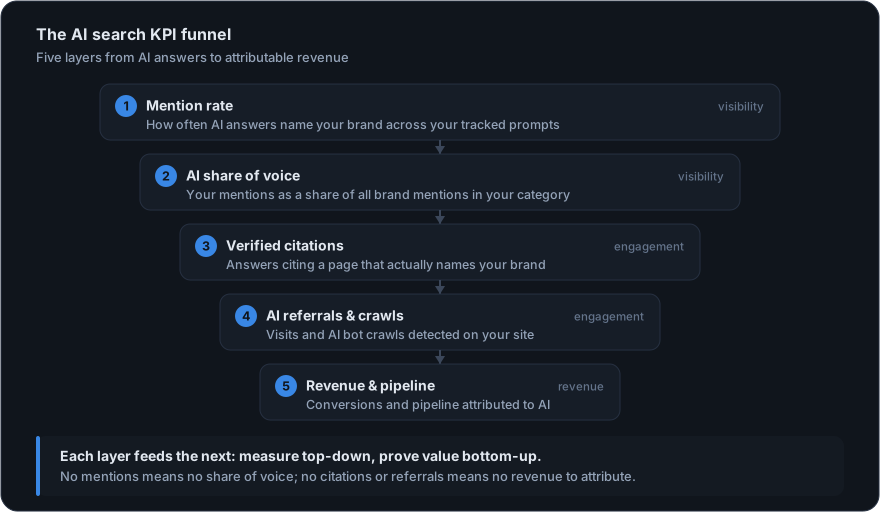
Let's break down each layer with the specific metrics you should track, how to measure them, and what "good" looks like.
Layer 1: Visibility KPIs
Before you can measure revenue, you need to know if AI platforms even know you exist. These metrics answer the question: "How visible is my brand in AI-generated responses?"
1. AI Share of Voice (AI SOV)
This is the most important top-of-funnel metric. AI Share of Voice measures how often your brand is mentioned relative to competitors across AI platforms, for prompts relevant to your industry. Geonimo computes it daily from repeated sampling: see the AI Share of Voice feature for how it works in practice.
Formula:
AI SOV = (Your Brand Mentions / Total Brand Mentions for Your Category) x 100
How to measure it:
- Define 25-100 prompts that your target audience would ask AI platforms (e.g., "best CRM for small business," "top project management tools")
- Run these prompts on the engines your buyers actually use (Geonimo tracks ChatGPT, Google AI Mode, and Perplexity daily)
- Track which brands are mentioned in each response
- Calculate your share vs. total mentions across all tracked competitors
- Repeat the runs. AI answers are non-deterministic, so a single pass is a coin flip. Sample the same prompts daily and report the score with a confidence interval: Geonimo reports AI share of voice at a 95% confidence interval and labels week-over-week moves that fall inside it as "ns" (not significant), so you react to real shifts instead of noise.
What good looks like:
- Below 5% - You're essentially invisible. AI doesn't know you well enough to recommend you.
- 5-15% - You're on the radar but not a default recommendation. Competitors are dominating.
- 15-30% - Solid presence. You're regularly mentioned alongside category leaders.
- 30%+ - Category leader status. AI platforms consider you a primary recommendation.
2. Mention Frequency Rate
While SOV gives you relative position, Mention Frequency tells you the absolute volume of AI mentions over time. This is critical for trend analysis.
Formula:
Mention Frequency = Total Mentions / Total Prompts Analyzed per Period
Track this weekly or monthly to spot trends. A rising frequency means your optimization efforts are working. A declining frequency - even if SOV is stable - means competitors are catching up.
3. Mention Position
Not all mentions are equal. Being the first brand mentioned in an AI response carries significantly more weight than being listed fifth. Position matters because:
- Users read AI answers top-down, and the first recommendation captures a disproportionate share of attention and action
- The first-mentioned brand is perceived as the "default" recommendation
- Many users stop reading after the first 2-3 recommendations
Track what percentage of your mentions are in position 1, 2, 3, or lower. Aim to increase your share of top-2 positions over time.
4. Platform Coverage
Are you visible on one AI platform or all of them? Platform Coverage measures the breadth of your AI presence:
Formula:
Platform Coverage = (Platforms Where You Appear / Total Platforms Monitored) x 100
A brand that's visible on ChatGPT but invisible on Perplexity and Google AI Mode is leaving massive traffic on the table. Each platform has its own user base and use case, and their recommendations don't always align. Geonimo measures three engines today (ChatGPT, Google AI Mode, and Perplexity), so coverage is scored out of three, with a per-engine breakdown.
5. Sentiment Score
Being mentioned isn't enough if AI platforms are warning users about your brand. Sentiment Score tracks the qualitative nature of your mentions:
- Positive (+1): "Brand X is widely regarded as the best option for..."
- Neutral (0): "Brand X offers this feature along with competitors Y and Z"
- Negative (-1): "While Brand X is an option, users have reported issues with..."
Aggregate sentiment across all mentions to get a -1 to +1 score. Track changes monthly. A sudden drop in sentiment usually signals a PR issue or a competitor gaining trust signals that push you down. Geonimo scores this automatically per mention: see sentiment analysis.
Layer 2: Engagement KPIs
Visibility means nothing if it doesn't drive action. These metrics answer: "Is AI visibility actually sending people to my website?"
6. AI-Attributed Traffic
This is the total number of website visits that can be attributed to AI platform recommendations. The challenge: most AI traffic doesn't carry a referrer.
How to measure it (three methods):
- Direct referral tracking - Some AI platforms (like Perplexity) do pass referral data. Track visits from
perplexity.ai,chatgpt.com, andclaude.aireferrers. - AI bot detection - Track when AI crawlers (GPTBot, PerplexityBot, ClaudeBot, Googlebot-Extended) visit your site. This correlates with future AI mentions. Geonimo's AI Tracker does this out of the box as part of AI traffic analytics, detecting both AI bot crawls and AI referrers.
- Behavioral correlation - Compare spikes in direct/unattributed traffic with known AI mention events. If your brand was mentioned in ChatGPT for "best CRM" on Tuesday and direct traffic to your CRM page spiked 40% on Wednesday, that's AI-driven.
7. AI Traffic Quality Score
Not all traffic is equal. AI-referred visitors tend to be higher intent because they've already been "pre-sold" by an AI recommendation. Measure:
- Pages per session for AI-attributed visitors vs. overall average
- Average session duration for AI-attributed visitors vs. other channels
- Bounce rate comparison between AI traffic and your other acquisition channels
- Scroll depth - AI visitors tend to engage more deeply with content
Run these comparisons on your own data rather than trusting industry benchmarks: the pattern of higher engagement from AI traffic is common, but the magnitude varies by category.
8. Citation Rate
When AI platforms cite your website as a source (with a link), it's the most valuable form of AI mention. Citation Rate measures:
Formula:
Citation Rate = (Mentions with Direct Link / Total Mentions) x 100
Perplexity cites sources most consistently (nearly every response includes links). ChatGPT cites less frequently. A high citation rate means your content is structured in a way that AI considers "source-worthy."
One measurement rule matters here: only count verified citations. A citation should count only when the cited page actually names your brand, otherwise the metric gets inflated by links that merely appear near your mention. This is how Geonimo's AI citation tracking credits citations, and it is the difference between a KPI you can defend in a board deck and one you can't.
9. Source Authority Index
Which domains are being cited alongside your brand? Track the sources that AI platforms use when mentioning you. If authoritative domains (industry publications, major media) cite you, AI platforms are more likely to continue recommending you.
Build your Source Authority Index by tracking:
- Total unique domains citing your brand in AI responses
- Domain authority scores of those sources
- Frequency of citation per domain
- New sources appearing over time (expansion rate)
Layer 3: Revenue KPIs
This is where it gets real. These metrics answer the only question executives actually care about: "How much money is AI search making us?"
10. AI-Attributed Conversions
The number of conversions (sign-ups, purchases, demo requests) that can be traced back to an AI platform touchpoint within the customer journey.
Attribution models for AI:
- First-touch: If the first known touchpoint was an AI referral, the conversion is AI-attributed
- Last-touch: If the user came from an AI platform in their final session before converting
- Multi-touch: AI gets partial credit if it appeared anywhere in the journey (recommended)
- Post-view: The user converted within 7 days of a known AI mention of your brand, even without a direct click
The post-view model is particularly important for AI search because of the "dark funnel" problem - users discover your brand in ChatGPT but arrive on your site through a Google search or direct visit days later.
11. AI Revenue
The total revenue generated from AI-attributed conversions. This is the number your CFO wants to see.
Formula:
AI Revenue = AI-Attributed Conversions x Average Deal Value
For SaaS companies, also track AI-attributed MRR (Monthly Recurring Revenue) and expansion revenue from AI-sourced accounts.
12. AI Search ROI
The return on investment for your AI search optimization efforts. This tells you whether your GEO program is worth the spend.
Formula:
AI Search ROI = ((AI Revenue - GEO Investment) / GEO Investment) x 100
GEO Investment includes:
- AI visibility monitoring tools (like Geonimo: see pricing)
- Content creation specifically for AI optimization
- Technical SEO/GEO implementation costs
- Team time allocated to GEO strategy
GEO investment is usually modest compared to paid channels, so even a handful of AI-attributed customers can put the ROI in positive territory. But that is a hypothesis to verify with this formula, not an assumption to bank on.
13. Customer Acquisition Cost from AI (AI CAC)
How much does it cost to acquire one customer through AI search?
Formula:
AI CAC = Total GEO Investment / AI-Attributed New Customers
Compare this to your CAC from other channels (paid search, social ads, content marketing). AI recommendations carry inherent trust, so many teams find AI CAC compares favorably to paid search CAC. Run that comparison on your own numbers: it is the strongest budget argument you can make, and it only works if the data is yours.
14. AI-Influenced Pipeline Value
For B2B companies, track the total pipeline value where AI was a touchpoint, even if it wasn't the converting channel:
- Deals where the prospect mentioned discovering your brand through AI
- Leads who visited your site from an AI referrer before entering the pipeline
- Accounts where AI bot activity on your site preceded the first demo request
This metric captures the "assist" value of AI search, which is often larger than direct attribution suggests.
Building Your AI Search Dashboard
Knowing which KPIs to track is half the battle. Here's how to actually set up measurement:
Step 1: Establish Your Prompt Library
Start with 25-50 prompts that represent how your target audience searches. Organize them by:
- Category prompts: "best [product category]" - measures category-level visibility
- Comparison prompts: "[your brand] vs [competitor]" - measures head-to-head positioning
- Problem prompts: "how to solve [problem your product solves]" - measures solution awareness
- Review prompts: "is [your brand] good for [use case]" - measures reputation
- Local prompts: "best [product] in [city/region]" - measures geographic coverage
Favor unbranded prompts: they capture how buyers ask before they know brand names, which is where recommendations are actually won. Prompt tracking manages this portfolio and runs it daily.
Step 2: Set Up AI Traffic Tracking
Deploy tracking that can identify AI-driven traffic beyond standard referral data:
- Install an AI traffic tracker (like Geonimo's AI Traffic Analytics) that detects AI bot crawls and AI platform referrers
- Configure your analytics to segment AI-referred visitors separately
- Set up conversion tracking for AI-attributed goals
- Create custom reports that overlay AI mention data with traffic and conversion data
Step 3: Define Your Baseline
Before you optimize anything, measure where you stand today:
- Run your full prompt library across all platforms and record current AI SOV
- Identify which competitors dominate each prompt category
- Document your current mention frequency, position distribution, and sentiment
- Estimate current AI-attributed traffic (even if rough)
This baseline becomes your "before" snapshot. Without it, you can't prove that your GEO efforts moved the needle. For a fast first read, run the free AI visibility score, then follow the full process in how to run an AI visibility audit.
Step 4: Set Targets and Review Cadence
Weekly review:
- Mention frequency and position changes
- AI-attributed traffic trends
- New sources citing your brand
Monthly review:
- AI SOV vs. competitors
- AI-attributed conversions and revenue
- Sentiment trends
- Platform coverage changes
Quarterly review:
- AI Search ROI calculation
- AI CAC vs. other channel CAC
- Pipeline influence analysis
- Strategy adjustments based on data
Common Measurement Mistakes to Avoid
Mistake 1: Only Tracking One Platform
ChatGPT gets the headlines, but Google's AI answers and Perplexity serve huge audiences of their own. Your visibility can vary wildly across platforms - you might be #1 on Perplexity and invisible on ChatGPT. Check where you stand on each engine: ChatGPT, Google AI Mode, and Perplexity.
Mistake 2: Counting Mentions Without Context
"We got mentioned 200 times this month" means nothing without knowing: In what context? First position or last? Positive or negative sentiment? For high-intent prompts or irrelevant ones? Quality of mentions matters more than quantity.
Mistake 3: Ignoring the Dark Funnel
Most AI-influenced conversions won't show "AI" as the source. A user asks ChatGPT for recommendations, gets your brand name, then Googles you directly two days later. If you only track last-touch attribution, AI search gets zero credit for that conversion. Use longer attribution windows and post-view models.
Mistake 4: Measuring Too Infrequently (or Trusting Single Measurements)
AI responses change constantly. A monthly check might miss a two-week window where a competitor overtook you after publishing a viral report. Weekly monitoring is the minimum for competitive categories, and daily sampling is better, because week-over-week swings are normal in AI answers (see the state of AI search visibility in 2026). The practical fix: report every score with a confidence interval, and label moves that fall inside it "ns" rather than celebrating or panicking over them.
Mistake 5: Not Connecting Visibility to Revenue
The biggest mistake of all. If you can't draw a line from "we're mentioned 30% of the time on ChatGPT" to "that drives $X in revenue," your GEO program will lose budget at the next quarterly review. Revenue attribution isn't optional - it's what keeps the program alive.
The KPIs That Don't Matter (Anymore)
As you build your AI search measurement framework, actively ignore these metrics that worked for traditional SEO but mislead in AI search:
- Keyword rankings - AI doesn't return ranked blue links. Your "position" in an AI response is completely different from your Google ranking.
- Organic impressions - AI search doesn't report impressions. You're either mentioned or you're not.
- Backlink count - While authority matters, AI platforms weigh content quality and entity recognition more than raw backlink profiles.
- Page authority scores - AI doesn't use Moz or Ahrefs scores. It evaluates content on its own criteria.
- Click-through rate - Many AI interactions don't involve clicks at all. The value is in the recommendation itself.
Putting It All Together: An Illustrative Example
Let's say you're a B2B SaaS company selling project management software. Here's what your AI search dashboard might look like after 90 days of GEO optimization. The numbers below are illustrative, not benchmarks: your baseline and growth will depend on your category and starting position.
90-Day AI Search Performance
| Metric | Result |
|---|---|
| AI Share of Voice | 8% → 22% (+175%) |
| Mention Frequency (weekly) | 12 → 47 (+292%) |
| Top-2 Position Rate | 15% → 38% |
| Platform Coverage | 1/3 → 3/3 |
| AI-Attributed Traffic (monthly) | 340 → 1,890 visitors |
| AI-Attributed Conversions | 8 → 67 sign-ups |
| AI Revenue (MRR) | $2,400 → $18,900 |
| AI CAC | $89 (vs. $340 paid search) |
That's the difference between "we're doing some AI stuff" and "AI search is our most efficient customer acquisition channel." The data tells the story - but only if you're measuring the right things.
Start Measuring What Matters
The brands winning in AI search aren't the ones with the biggest budgets. They're the ones with the best measurement systems. They know exactly which prompts drive revenue, which platforms deliver the highest-quality traffic, and which content strategies move the needle.
You can't optimize what you can't measure. And in AI search, most brands are flying completely blind.
Start with the basics: set up AI share of voice tracking, deploy an AI traffic tracker, and define your baseline. Then layer in engagement and revenue metrics as your program matures. Within 90 days, you'll have a clear picture of whether AI search is a growth channel or a vanity project.
If you want the baseline done for you, book a free audit: the Geonimo team runs your prompt set across ChatGPT, Google AI Mode, and Perplexity and walks you through the numbers.
The question isn't whether AI search will impact your revenue. It already is. The question is whether you'll measure it well enough to capture the opportunity.
Related Articles