To get cited by AI search engines, you need four things: pages the AI crawlers can retrieve, answers structured so a model can lift them cleanly, third-party mentions on the sources each engine already trusts, and a way to measure your citation rate per engine so you know what is working. That is the whole playbook in one sentence. The rest of this guide turns it into specifics.
Your website may rank on Google, but AI search engines do not return ten blue links. They synthesize a single response, cite a handful of sources, and move on. If you are not one of those sources, you are invisible to that prompt.
This guide explains, in concrete terms, how each major AI search engine picks the sources it cites, what kinds of content they prefer, and what you can do about it. The advice is based on our analysis of 2.1 million citations across 567,000 domains, plus the operating patterns we see inside the brands that win consistently.
The short version: getting cited by AI is not a hack. It is a measurable optimization problem with clear levers. Pull the right ones and you compound. Pull none of them and your competitors get the answer slot.
What does it mean to "get cited" by an AI search engine?
A citation is any moment an AI assistant references your brand, your domain, or a specific URL on your site inside a generated answer. There are two flavors that matter, and they are often confused.
The first is a linked citation: a clickable source pinned next to or inside the response. Perplexity and Google AI Overviews surface these aggressively. The second is a brand mention: the AI names your company or product in the answer body, with or without a link. ChatGPT and Claude lean heavily on this format, especially in recommendation queries.
Both count. Both drive discovery, trust, and qualified traffic. And both are influenceable, even though the underlying retrieval and ranking systems are opaque.
Why AI citations matter more than rankings in 2026
Classic SEO assumes the searcher will scan a page of results and pick one. AI search collapses that step. The model picks for them. By the time a buyer reads the answer, the shortlist has already been built without their input, and your brand was either on it or not.
That changes the unit of growth. A page that ranks third for a high-intent query but never gets cited by an AI assistant earns a fraction of the demand it used to capture. A page that ranks tenth but gets cited every time gets the conversation. Treating "rank" as the only KPI in 2026 is the same mistake as treating impressions as the only KPI in 2015.
How AI search engines choose which sources to cite
Every major AI search system uses a variation of the same four-step pipeline. Understanding it makes the optimization work obvious.
Step 1: Query understanding. The model parses the buyer's question into one or more sub-questions. ChatGPT and Gemini in particular use query fan-out, where a single prompt becomes five or more retrieval queries behind the scenes. You are not optimizing for one keyword. You are optimizing for a cluster of related questions.
Step 2: Retrieval. The model pulls candidate documents from a search index, an internal knowledge cache, or both. Perplexity hits live web search. ChatGPT and Claude blend Bing-backed search with their own retrieval layers. Gemini uses Google's index. If your page is not crawlable, indexable, and topically relevant, you do not even enter the candidate pool. The free AI crawlability checker tests whether the major AI crawlers can reach your site in seconds.
Step 3: Selection. The model ranks candidates on a mix of authority signals, passage-level relevance, freshness, and citation-readiness. Pages that read like clean, self-contained answers get picked over pages that bury the answer in marketing fluff.
Step 4: Synthesis. The model writes the response and decides which sources to name. Brand mentions in the answer body usually go to entities the model already knows from training data. Linked citations usually go to the documents it just retrieved. You need to win on both fronts.
The seven traits of pages that AI engines cite the most
Across the 2.1 million citations we analyzed, the cited pages share a recognizable pattern. The pattern is consistent across ChatGPT, Claude, Perplexity, and Gemini, even though the engines weight things differently.
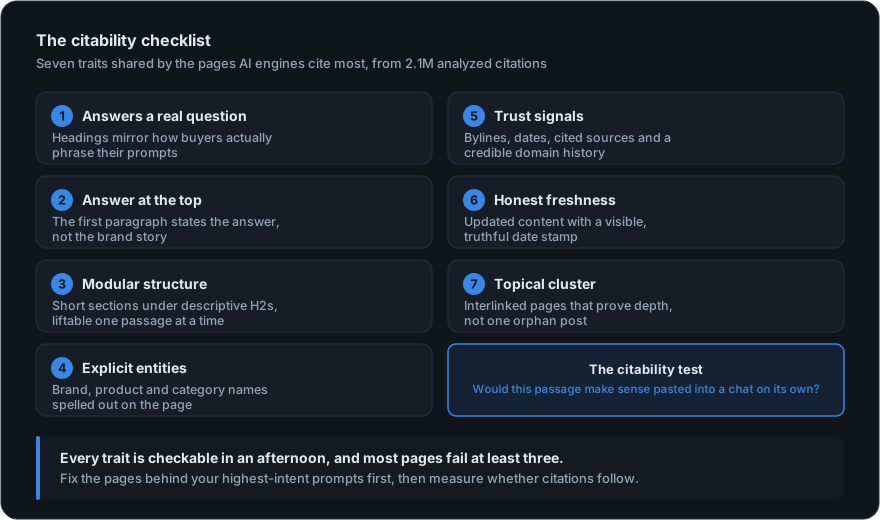
1. The page answers a real question, not a keyword. Cited pages tend to mirror the way buyers actually phrase prompts. Question-shaped headings, explicit definitions, and clear intent matching all help.
2. The answer is near the top. AI models extract the first concrete answer they find. If your value proposition appears in paragraph nine, it does not exist for retrieval purposes.
3. The structure is modular. Short sections under descriptive H2 and H3 headings let the model lift one passage cleanly without dragging in unrelated context.
4. The entities are explicit. Brand names, product names, competitor names, and category terms are spelled out, not hidden behind pronouns. Entity density feeds the knowledge graph.
5. The page is trustworthy. Author bylines, publish dates, source citations, and a credible domain history all influence which candidates survive the selection step.
6. The freshness signal is honest. AI engines downweight stale pages on time-sensitive topics. A 2022 ranking guide loses to a 2026 one, even if the older one ranks higher in classic SEO.
7. The page is part of a wider topical cluster. Single posts rarely earn citations on their own. Coverage of a topic across multiple pages, supported by internal linking, signals depth.
How to get cited by ChatGPT
ChatGPT cites brands in two ways. In recommendation prompts ("best CRM for early-stage startups"), it names entities it knows from training data, sometimes without any source link. In research prompts ("compare X and Y"), it pulls live results via Bing-backed search and surfaces source links inline.
To win the first kind, you need to exist in the model's prior. That means consistent brand mentions across editorial coverage, review sites, community discussions, and your own pages, sustained over months. To win the second, you need clean, citation-ready pages on the exact comparison and category queries your buyers run.
ChatGPT also respects structured pages. Comparison tables, FAQ blocks, and explicit "what is X" sections are over-represented in its citations. If you sell software, a clean alternatives page beats a long brand essay every time. The full on-page playbook is in our guide to ChatGPT SEO.
To see how often ChatGPT already mentions your brand on the prompts that matter, use the ChatGPT visibility tracker, and see how to track brand mentions in ChatGPT for the measurement workflow.
How to get cited by Claude
Claude is more conservative about naming brands without justification. It tends to favor explanatory content over marketing copy, and it frequently cites authoritative editorial sources, documentation, and well-structured guides.
The lever here is depth. Claude's responses reward pages that explain a concept thoroughly and qualify their claims. Thin landing pages and listicles without substance get filtered out. If your category has a "definitive guide" slot open, that is the page Claude will reach for.
Documentation matters more than most teams expect. Claude often cites docs and developer-facing pages even on commercial queries, because they are unambiguous and well-structured.
How to get cited by Perplexity
Perplexity is the most citation-transparent of the four. Every answer comes with numbered sources, and the engine is biased toward fresh, retrievable content. If you can be found in real-time web search, you have a fair shot at being cited.
Perplexity rewards two things in particular. First, recency: a published or updated date the engine can read, paired with content that genuinely reflects that date. Second, passage clarity: a single self-contained paragraph that answers the sub-question is more likely to be quoted than a sprawling section that requires synthesis.
Reddit, in our data, is the single most-cited domain across AI engines, and Perplexity is a major reason why. Community discussion, when it surfaces your brand favorably, becomes a durable citation source.
The Perplexity visibility tracker shows which of your prompts Perplexity already cites you on, and which ones it hands to competitors.
How to get cited by Gemini and Google AI Overviews
Gemini draws on Google's index, which means classic SEO fundamentals translate the most directly here. Crawlability, helpful content, structured data, page experience, and topical authority all carry over. Google has stated there is no special markup or AI-only file required to appear in AI Overviews.
What changes is the answer-readiness layer on top. AI Overviews assemble responses from multiple supporting pages via query fan-out, so a page that ranks well but reads like a sales sheet will be passed over for a page that ranks slightly lower but reads like a clean answer. You need both. The same logic applies conversationally in Google AI Mode: the Google AI Mode visibility tracker shows whether your brand appears in its answers today.
For Gemini specifically, schema markup pulls extra weight. FAQ schema, HowTo schema, and Article schema help the engine identify which passages are worth lifting.
Who needs to optimize for AI citations?
Almost every brand whose buyers research before they buy. The use cases differ, but the underlying need is the same: be the source the AI reaches for when your category comes up.
- B2B SaaS companies appearing in "best tool for X" comparisons
- DTC brands showing up when buyers ask AI for product recommendations
- Agencies and consultancies being named in "who should I hire for X" prompts
- Publishers and creators earning citations as authoritative editorial sources
- Local and service businesses mentioned in regional queries through AI search
- Marketplaces and aggregators being the source AI engines pull listings from
The category boundaries blur fast. If a buyer can plausibly type your problem into ChatGPT, you have a citation strategy to run.
How to measure your AI citation performance
You cannot improve what you cannot see. Most teams discover their AI visibility gap by accident, usually when a sales rep mentions a prospect found a competitor through ChatGPT. By that point, the gap has been there for months.
A working measurement loop tracks four things. The prompt universe: the actual buyer questions you want to win, not a keyword list. The citation rate per engine: how often each AI assistant names your brand or links your domain on those prompts, tracked with verified citation tracking. The source attribution: which third-party domains the AI is reaching for when it cites you, and which ones it cites instead of you, surfaced by AI sources analysis. And the traffic correlation: whether your AI visibility is translating into qualified sessions and conversions, measured on-site by the AI Tracker.
This is what Geonimo is built for. We run your prompt set across ChatGPT, Google AI Mode, and Perplexity daily, extract every brand mention and citation, and tie the results back to your traffic so the picture is operational, not academic.
Common mistakes that keep your brand out of AI answers
The same handful of mistakes account for most of the visibility gaps we see. None of them are exotic. They are the things teams know they should fix and never quite do.
Treating AI search like classic SEO. Optimizing for one keyword per page misses the fan-out behavior. Your page needs to answer a cluster of related sub-questions, not one head term.
Burying the answer. Long brand-led intros push the actual answer below the fold. The model gives up before it gets there.
Ignoring third-party surfaces. AI engines lean heavily on Reddit, review sites, editorial coverage, and documentation. Your owned content cannot carry the load alone. Ranked PR opportunities tell you which of those surfaces actually feed the answers in your category.
Skipping freshness. A category page last updated in 2023 sends a stale signal. Updating with current data and a visible date moves the needle quickly.
No measurement. Without tracking, you cannot tell whether your changes worked, which prompts you lost, or which competitor took the slot. The team optimizes blind and the budget gets cut.
Frequently asked questions about AI citations
How long does it take to get cited by ChatGPT or Claude?
For Perplexity and Gemini, which lean on live retrieval, you can see citation changes within days of publishing or updating a page. For ChatGPT and Claude, which rely more on entrenched brand priors, expect weeks to months of consistent third-party mentions before the model reliably names you in recommendation queries.
Do I need special schema markup for AI search?
No AI-only schema exists. Standard Schema.org markup, especially FAQ, HowTo, Article, Product, and Organization, helps AI engines parse your pages but is not a separate AI requirement. Google has been explicit that there is no special AI-only file to publish.
Should I publish an llms.txt file?
It does not hurt and some engines may use it in the future, but no major AI search engine currently treats llms.txt as a ranking signal. It takes a minute with the free llms.txt generator; after that, spend your time on content quality, structure, and measurement.
Why does Reddit get cited so much by AI engines?
Reddit combines high authority, fresh user-generated discussion, and explicit recommendations from real buyers. AI engines treat it as a trust signal because the content is opinionated, current, and clearly attributed to humans. In our 2.1 million citation dataset, Reddit was the single most-cited domain across the engines we measure.
Can I pay to get cited by an AI search engine?
No. There is no ad slot inside ChatGPT, Claude, Perplexity, or Gemini answers today. Citations are earned through retrieval relevance and brand authority, which is exactly why GEO is becoming a discipline of its own.
What content types get cited the most?
In our analysis, corporate pages led with 60.6 percent of citations, followed by editorial content, documentation, and community discussion. The long tail is real: 73.5 percent of citations came from domains outside the top 100, which means smaller brands with sharp content can absolutely compete.
How do I track which prompts mention my brand?
You need a tool that runs your prompt set across the major AI engines on a recurring schedule, extracts brand mentions and citations, and stores the history so you can see trends. Geonimo does this daily and ties the results back to traffic, but the principle applies whatever tool you use.
Can a small brand realistically compete for AI citations?
Yes. The long-tail data shows that smaller domains earn citations every day. The advantage goes to whoever produces the cleanest, most specific answer for a given prompt, not whoever has the biggest backlink profile. A focused brand with a clear point of view beats a generic enterprise content farm in this game.
Where should I start if I do nothing else this quarter?
Define your prompt universe, measure your current citation rate across the three major AI engines, and identify the top ten prompts where competitors are cited and you are not. Fix the pages that should have won those prompts. That single loop, run weekly, is the highest-leverage move available.
Final takeaway
Getting cited by AI search engines is not a different game from SEO. It is the next layer on top of it. The fundamentals still matter: crawlable pages, helpful content, clear structure, real authority. What changes is the unit of success. You are no longer optimizing for a position in a list. You are optimizing for inclusion in an answer.
Brands that treat this as a measurable system will compound. Brands that wait for a hack will be told, eventually, that their competitors became the default answer in their category and that the buyer found them first.
If you want to see how your brand is performing across ChatGPT, Google AI Mode, and Perplexity today, you can book a free audit or explore pricing.