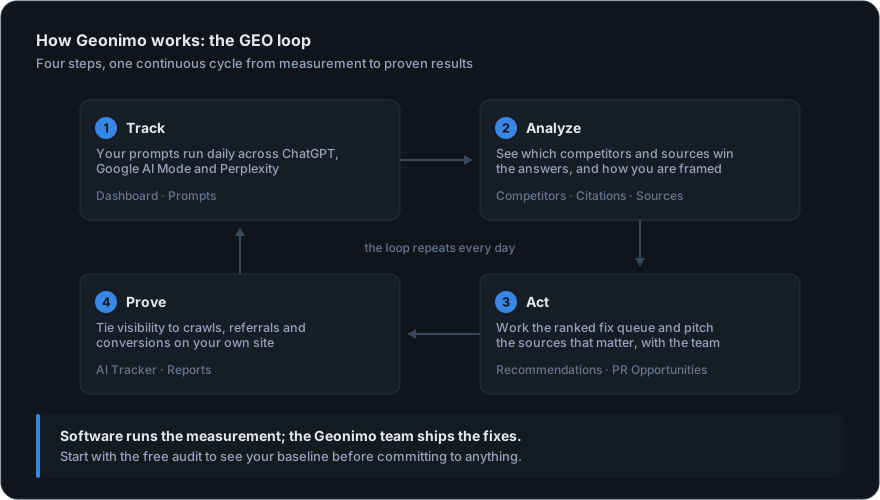
Using Geonimo is a four-step loop: track your brand daily across ChatGPT, Google AI Mode, and Perplexity; analyze which competitors and sources win the answers; act on the ranked recommendations and PR opportunities; and prove the results with the AI Tracker and reports. This guide walks through every step, from the free audit to the monthly review rhythm.
Why Generative Engine Optimization Matters
The way people search for information is fundamentally changing. Instead of typing keywords into Google and clicking through links, users are now asking questions to AI assistants like ChatGPT, Google AI Mode, and Perplexity, and getting instant, synthesized answers.
Here's the challenge: If your brand isn't mentioned in these AI-generated responses, you're invisible to an entire generation of users who never click through to traditional search results.
Geonimo is an AI visibility platform with a team inside: software that tracks and measures your brand across AI search engines, plus a human GEO team that ships the fixes the data calls for. This guide will walk you through everything you need to know to leverage Geonimo for Generative Engine Optimization (GEO).
Whether you run a B2B SaaS, an e-commerce store, a local service business, or an agency managing client brands, the same GEO fundamentals apply, and Geonimo adapts to your market.
Getting Started: From Free Audit to Live Tracking
Step 1: Book Your Free Audit
Geonimo starts with a free audit, not a self-serve signup. Book your free audit and the team will analyze your brand's current visibility across ChatGPT, Google AI Mode, and Perplexity, walk you through the findings, and set up your workspace. Come prepared with:
- Your website URL
- Your company/brand name
- A shortlist of competitors you care about (optional, Geonimo can suggest them)
Step 2: Brand Discovery
Once your workspace is created, Geonimo will guide you through a 3-step onboarding process to understand your brand and competitive landscape:
Discovery Process:
- Website & Location: Enter your website URL and select your primary target location (US, UK, EU, etc.). Geonimo will automatically analyze your website to understand your industry and value proposition.
- Competitors: Geonimo's AI will suggest 10-15 competitors based on your industry. Review each one and click "Track" to monitor them, or dismiss irrelevant suggestions with the X button.
- Prompts: Choose from AI-suggested search queries relevant to your industry, or create custom prompts. These are the questions Geonimo will ask AI engines to track your brand mentions.
Pro Tip: Start with 20-30 prompts covering different aspects of your business (product features, use cases, comparisons, industry terms). You can always add more later.
Step 3: Choose Your Plan
Geonimo offers three plans tailored to different business needs:
- Growth ($199/month, or $159/month billed yearly): For brands getting serious about AI visibility
- Expansion ($399/month, or $319/month billed yearly): For growing teams tracking more prompts, markets, and competitors, with monthly strategy reviews led by the Geonimo team
- Scale (custom pricing): For agencies and large brands managing multiple products, adding white-label reporting, weekly team-written reports, and a dedicated success manager
Every plan runs daily analysis on all three engines: ChatGPT, Google AI Mode, and Perplexity. The free audit comes before any commitment, so you see your baseline first. See full pricing details.
Understanding Your Dashboard
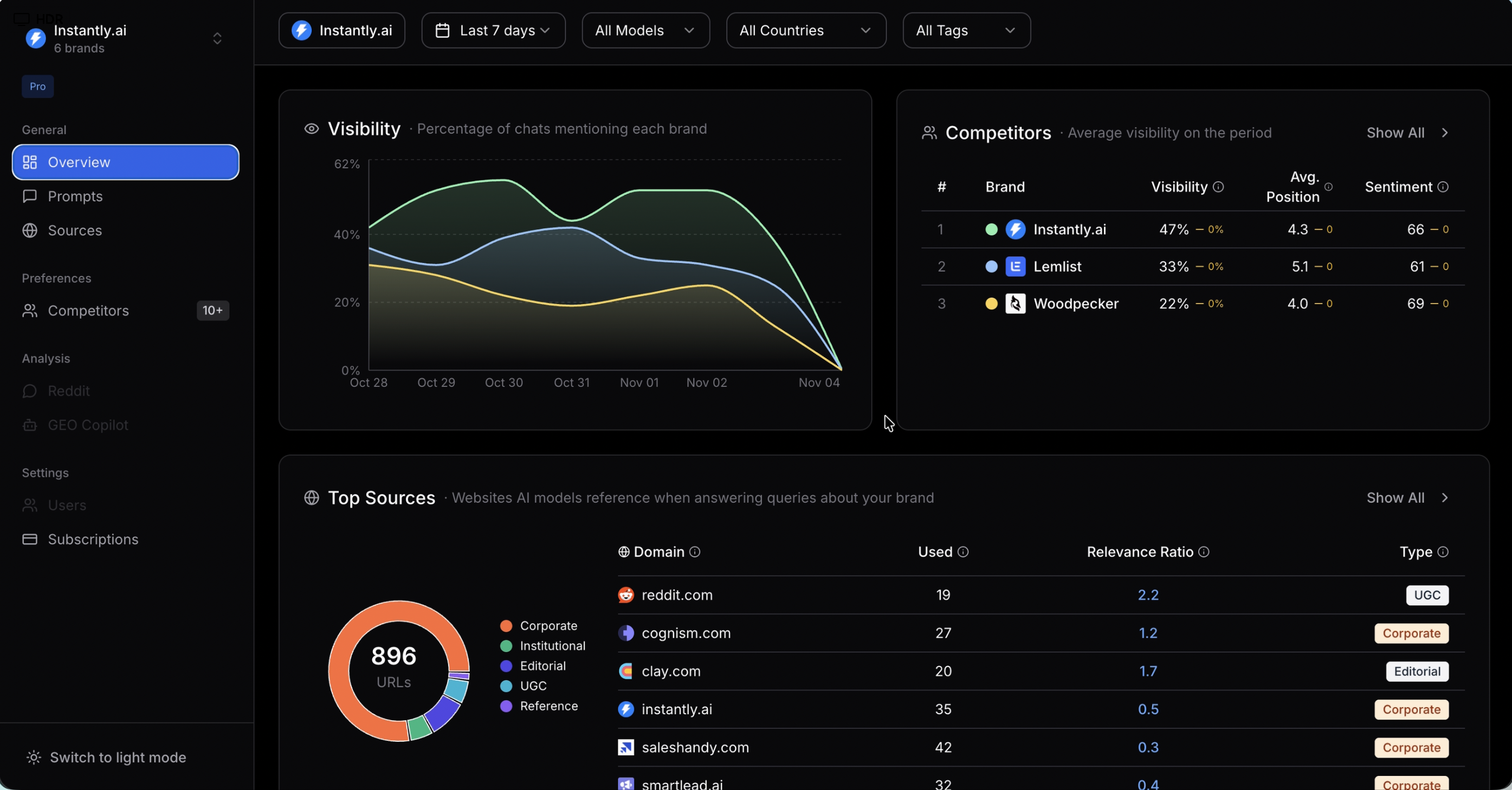
Once your workspace is set up, Geonimo begins its first analysis cycle, with first insights typically available within 24 hours. Your dashboard provides a comprehensive view of your GEO performance. For a deeper look at how the tracking works, see the AI visibility monitoring feature page.
Key Metrics at a Glance
Visibility Score
Your overall GEO performance scored 0-100. This combines mention frequency, position ranking (1st, 2nd, 3rd), and sentiment across all three engines. Higher scores indicate stronger AI search visibility.
Mention Trends
Track how often your brand appears in AI responses over time. The graph shows daily/weekly mention counts with percentage changes, helping you identify momentum and correlate spikes with specific campaigns.
Provider Breakdown
See which AI engines mention your brand most frequently. ChatGPT, Google AI Mode, and Perplexity each have different knowledge bases and content preferences.
Recent Chats
Browse the latest AI conversations where your brand was mentioned. Click any chat to see the full context, sentiment analysis, and citation sources.
Competitor Intelligence: Understanding Your Competitive Landscape
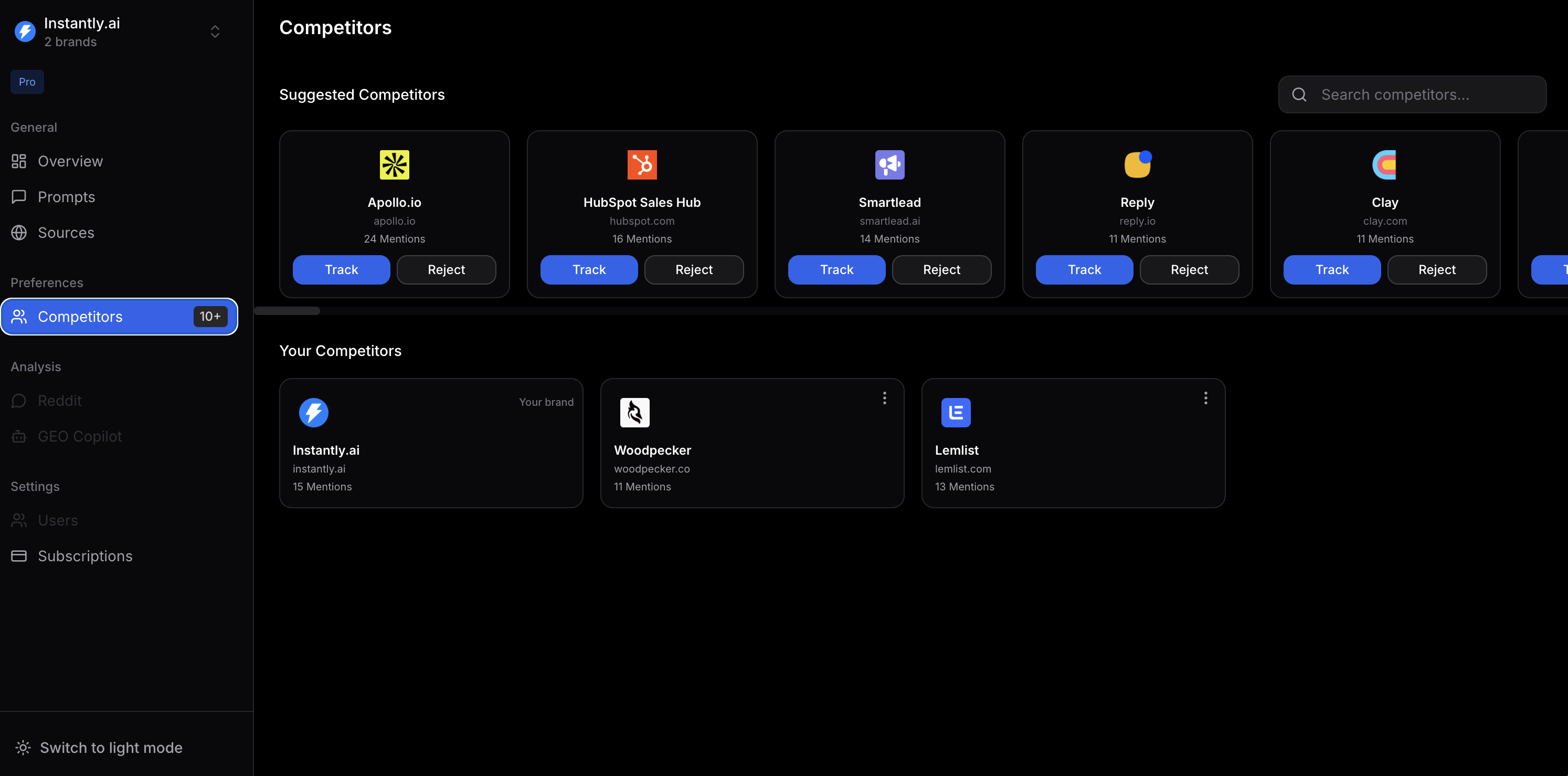
The Competitors tab is where Geonimo's strategic value truly shines. By tracking how often competitors appear in AI responses compared to your brand, you can identify visibility gaps and opportunities.
What You'll See
- Average visibility on the period: Each competitor's mention frequency during the selected timeframe
- Mention counts: How many times each competitor appeared in AI responses to your tracked prompts
- Direct comparison: Your brand's mentions vs. competitors in a clear, sortable table
- Trend analysis: Track if competitors are gaining or losing visibility over time
Managing Competitors
You can dynamically manage your competitive tracking:
- Edit: Click the three-dot menu next to any competitor to update their name or website
- Merge: Consolidate duplicate entries if the same competitor was tracked under different names
- Remove: Stop tracking competitors that are no longer relevant to your market
Strategic Insight: If a competitor consistently ranks higher than your brand, analyze which prompts drive their mentions. Then, optimize your content strategy to target those same queries with better, more comprehensive information.
Prompt Optimization: Fine-Tuning Your Queries
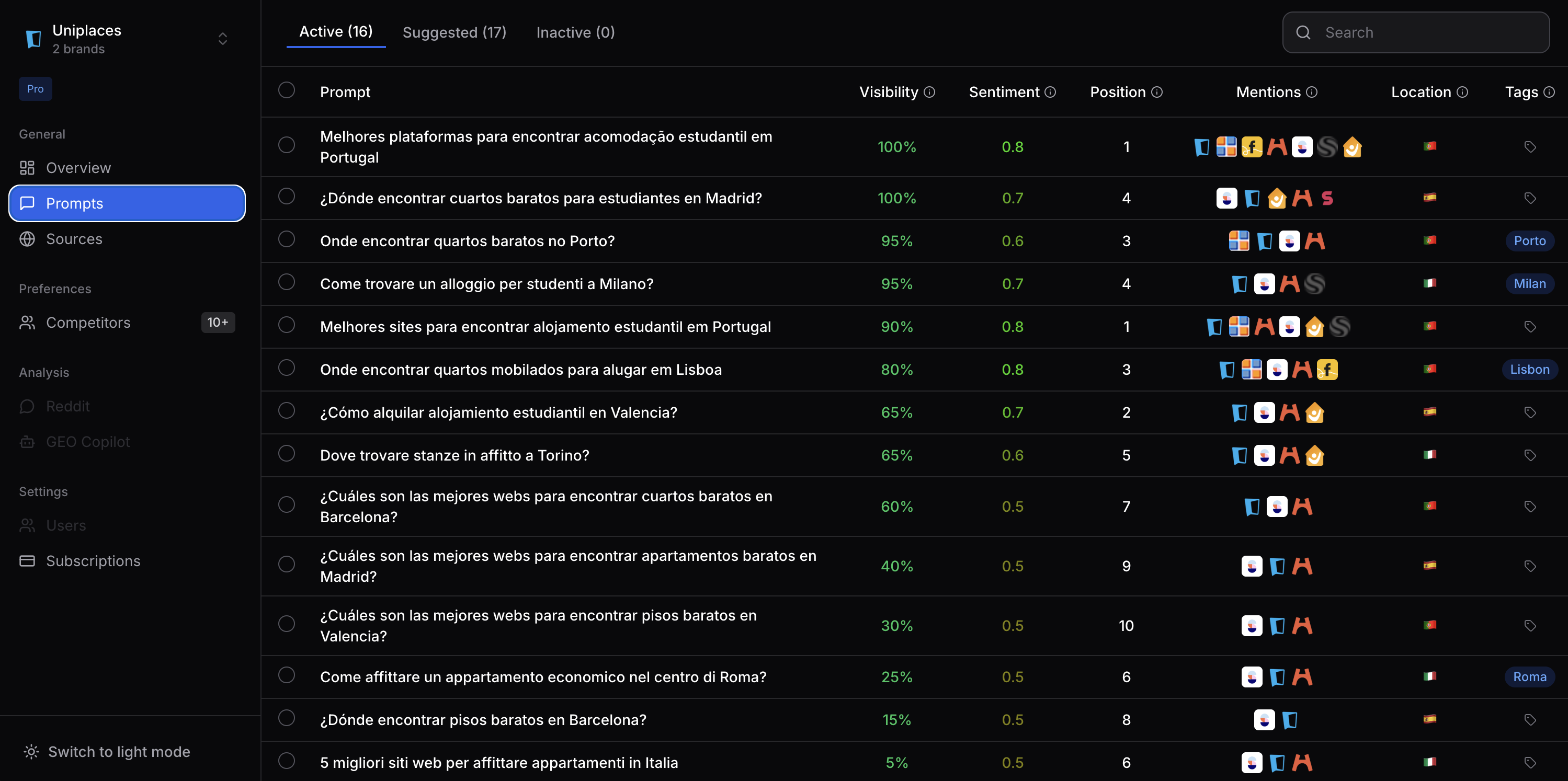
Prompts are the foundation of your GEO strategy. These are the exact questions Geonimo asks AI engines during each analysis cycle. The better your prompts, the more actionable your insights.
Prompt Performance Metrics
For each prompt, Geonimo tracks:
- Mention count: How many times your brand appeared in responses to this prompt
- Average position: Where your brand typically ranks (1st, 2nd, 3rd) when mentioned
- Provider performance: Which AI engines respond best to this prompt
- Trend over time: Is this prompt becoming more or less effective?
Adding Custom Prompts
Click the "Add Prompt" button to create new search queries. Effective prompts should:
Best Practices for Prompts:
- Be specific: "Best project management tools for remote teams" vs. "project management software"
- Include use cases: "How to track website citations in AI search engines"
- Cover comparisons: "Geonimo vs Otterly AI vs Profound for GEO tracking"
- Target pain points: "How to measure ChatGPT visibility for my brand"
- Think like your audience: What questions would prospects ask before discovering your solution?
Prompt Lifecycle Management
Regularly review and optimize your prompt library:
- Archive underperforming prompts: If a prompt generates zero mentions for 30+ days, either refine it or archive it
- Test variations: Create multiple versions of high-value prompts to find the optimal phrasing
- Seasonal adjustments: Add/remove prompts based on industry trends, product launches, or seasonal demand
- Competitive prompts: Monitor prompts where competitors dominate and create content to compete
Tip: Keep your prompt library focused on queries that reflect how buyers actually search. Archive old prompts to make room for new experiments.
Citation Analysis: Understanding Your Source Authority
When AI engines mention your brand, they cite sources to support their statements. Geonimo's AI citation tracking reveals which websites and content drive your AI visibility.
Why Citations Matter
AI search engines prioritize information from authoritative, credible sources. If your brand is frequently mentioned on high-authority sites (industry blogs, news outlets, research papers, review platforms), AI engines are more likely to recommend you.
Think of citations as backlinks for the AI era: The more quality sites mention your brand, the stronger your "AI authority" becomes.
Citation Insights
The Citations tab shows:
- Top citing sources: Which websites mention your brand most frequently in AI responses
- Citation snippets: The exact text AI engines extracted from each source
- Source authority: Editorial (news/blogs), Corporate (company sites), UGC (Reddit, forums), Reference (Wikipedia, docs)
- Competitor citations: Which sources cite competitors but not you (opportunity gaps)
Strategic Action: Identify sources that frequently cite competitors. Reach out to these publications with guest post pitches, case studies, or partnership opportunities to get your brand mentioned on high-value sites.
Source Intelligence: Domain and URL-Level Analysis
The Sources tab provides granular visibility into the content that influences AI engines through AI sources analysis. This goes deeper than citations, showing all sources referenced in AI responses, even if your brand wasn't mentioned.
Two Views of Source Data
Toggle between Domains and URLs to analyze source patterns:
- Domains View: See which websites (e.g., reddit.com, searchengineland.com) are most frequently referenced across all AI responses. Useful for identifying high-authority domains to target with content.
- URLs View: Drill down to specific articles and pages that AI engines cite. Analyze what makes these URLs valuable and replicate the content strategy.
Source Type Breakdown
Geonimo categorizes sources into five types:
- Corporate. Company websites, product pages, official blogs
- Editorial. News sites, industry publications, professional blogs
- UGC (User-Generated Content). Reddit, forums, review platforms, social media
- Institutional. Educational sites (.edu), research institutions, government (.gov)
- Reference. Wikipedia, documentation sites, knowledge bases
Insight: If AI engines primarily cite UGC sources for your industry, prioritize building presence on Reddit and forums. If Editorial sources dominate, focus on PR and guest blogging.
How to Use Source Intelligence
- Identify high-frequency domains: Sort by "Used as Source" count to see which websites AI engines trust most in your niche.
- Analyze competitor presence: Click into domains that frequently cite competitors to understand their content strategy.
- Create a target list: Compile domains with high citation frequency but low brand mentions. These are your top PR/content opportunities.
- Reverse engineer top URLs: Study the most-cited URLs to understand what format, depth, and angle AI engines prefer.
- Monitor changes: Track if new domains emerge as AI engines update their knowledge bases after major product launches or industry events.
Recommendations: Your Prioritized Action Queue
Data without action is just a dashboard. The Recommendations queue turns your measurements into a ranked to-do list, regenerated after collection runs so the advice always tracks the current data.
Recommendations come in three types:
- Gap recommendations: Buyer intents and prompts where your brand never appears while competitors do, ranked by how much of the market each gap represents
- Source opportunities: Trusted, repeatedly-cited pages in your market that don't mention you, the highest-leverage placements available to your brand
- Perception corrections: Claims AI models make about your brand that are wrong, outdated, or off-position, extracted from real answers and clustered by theme
Every recommendation cites the measurement it came from, so "why are we doing this?" always has an answer. You can execute the queue yourself, or the Geonimo team ships the fixes with you; on Expansion and above, your strategist walks the queue together with you in the monthly review.
PR Opportunities: Where to Pitch Next
AI assistants lean on a small set of sources when they answer questions in your category. PR Opportunities measures which ones: how often each domain is cited on your prompts, how consistently across runs, and whether the pages the engines trust actually name your brand.
The result is an outreach list ranked by measured influence rather than domain-authority folklore:
- Work the gap list first: Stable, much-cited domains whose pages name your competitors but not you
- Pitch at the page level: The specific URLs doing the work in your market, so a pitch can name the exact article a mention belongs in
- Watch the outcome: The same pipeline that found the opportunity measures the result: new citations from the domain and mention changes on the prompts it feeds
The AI Tracker: Crawls, Referrals, and Conversions
Everything above measures the answer side. The AI Tracker measures your site's side: which AI bots crawl your pages and which humans arrive from AI answers.
- Bot crawl tracking: Detect visits from AI crawlers and see exactly which pages they fetch. Crawls are the leading indicator that your content is entering AI answers.
- AI referral tracking: Identify human visitors arriving from ChatGPT, Claude, Gemini, Copilot, Grok, Meta AI, DeepSeek, Mistral, and other AI platforms, separated cleanly from organic, social, and direct traffic.
- Adblocker-proof capture: The recommended setup is a Cloudflare Worker that logs traffic server-side at the edge; a lightweight JavaScript tracker is available as an alternative.
- Conversions and behavior: URL-based conversion rules with revenue values, plus engagement metrics, so an AI referral is measured to the outcome, not just the landing.
Note the scope difference: Geonimo measures AI answers on three engines (ChatGPT, Google AI Mode, and Perplexity), while the AI Tracker detects crawls and referrals from a much wider set of AI platforms, because your server logs see everyone.
Advanced GEO Strategies
1. Multi-Location Testing
AI engines provide different responses based on geographic location. If your business serves multiple markets, create prompts with location modifiers:
- "Best GEO tools for UK startups"
- "Top AI analytics platforms in Singapore"
- "Generative engine optimization services in Australia"
2. Sentiment Tracking
Geonimo automatically analyzes sentiment (positive, neutral, negative) for each mention. If you notice negative sentiment trends:
- Investigate the source content and address concerns in your marketing
- Create positive case studies and testimonials to balance perception
- Reach out to publications spreading misinformation for corrections
3. Position Optimization
When your brand is mentioned, position matters:
- 1st position: Your brand is the primary recommendation (highest value)
- 2nd-3rd position: Listed as an alternative (good visibility)
- 4th+ position: Barely mentioned (low impact)
To improve position, ensure your content is more comprehensive, recent, and authoritative than competitors.
4. Prompt Testing Framework
Treat prompt optimization like A/B testing:
- Create 3-5 variations of the same query with different phrasing
- Run them for 2 weeks to gather statistically significant data
- Identify the highest-performing version (most mentions + best position)
- Archive underperforming variants and double down on winners
- Repeat monthly as AI models evolve
5. Content Gap Analysis
Use Geonimo data to identify content you should create:
- Prompts with zero brand mentions = content gaps
- Competitor-dominated prompts = competitive opportunities
- High-citation sources without your brand = outreach targets
Monitoring and Reporting
Analysis Frequency
Geonimo runs a full analysis cycle every day, on every plan. Each cycle queries all active prompts across ChatGPT, Google AI Mode, and Perplexity, extracts mentions, and updates your dashboard.
Reports That Reach Your Inbox
You don't need to live in the dashboard to stay on top of your AI visibility. GEO reports layer up with your plan:
- Weekly email report (every plan): Score movement, provider shifts, competitor changes, and notable events, delivered automatically
- Monthly strategy reviews (Expansion and above): The Geonimo team walks through your data with you monthly and agrees the priorities for the next month
- White-label reporting (Scale): Deliver Geonimo reporting under your own brand, alongside weekly team-written reports and a dedicated success manager, built for agencies managing client portfolios
What to Monitor Weekly
- Visibility score trend: Is it increasing or decreasing?
- Mention volume changes: Correlate spikes with marketing activities
- New competitor mentions: Are competitors gaining ground?
- Prompt performance: Which queries are driving the most mentions?
- Citation sources: Are new high-authority sites mentioning you?
Monthly Strategic Review
Once per month, conduct a deeper analysis:
- Compare month-over-month visibility scores across providers
- Identify your top 10 highest-performing prompts and create more variants
- Archive prompts with zero mentions for 60+ days
- Review competitor trends: who's rising, who's falling?
- Analyze source type distribution: are you reaching the right audiences?
- Export data for stakeholder reports (CFO, CMO, board)
Common Pitfalls to Avoid
Too Many Generic Prompts
Broad queries like "AI tools" or "project management software" return generic answers. AI engines rarely mention specific brands in overly general responses.
- Fix: Use specific, long-tail prompts that naturally lead to brand recommendations.
Ignoring Competitor Insights
Tracking competitors isn't about obsessing over rankings: it's about learning from their successes and failures.
- Fix: When a competitor dominates a prompt, reverse-engineer their content strategy and create something better.
Set It and Forget It
GEO is not a one-time setup. AI models are constantly updated with new training data, and your competitors are optimizing too.
- Fix: Review Geonimo weekly and adjust prompts, content, and strategy based on performance trends.
Not Diversifying Citation Sources
Relying solely on your own website or blog limits AI visibility. AI engines trust third-party validation more than first-party content.
- Fix: Build presence on Reddit, earn editorial coverage, contribute to industry forums, and get listed in authoritative directories.
Measuring GEO Success
How do you know if your GEO strategy is working? Track these key performance indicators:
Primary KPIs:
- Visibility Score: Target 10-20% month-over-month growth for established brands
- Mention Volume: Aim to increase total brand mentions by 25-50% quarterly
- Average Position: Move from 3rd to 1st position in high-value prompts
- Provider Coverage: Achieve consistent mentions across all three engines
- Competitive Share: Increase your mention share vs. top 3 competitors
Secondary KPIs:
- Citation Diversity: Number of unique domains citing your brand
- High-Authority Citations: Percentage of mentions from Editorial/Institutional sources
- Prompt Win Rate: Percentage of prompts where you rank #1
- Sentiment Score: Ratio of positive to negative mentions (target 80%+ positive)
Business Impact: While Geonimo tracks GEO-specific metrics, correlate them with business outcomes like website traffic, demo requests, and pipeline growth to prove ROI to leadership. The AI Tracker's conversion rules cover the AI-referral side of that equation directly.
What's on the Roadmap
Everything described above is shipped and available today. A few things you may see referenced on our site are roadmap items, not yet part of the product:
- Answer tracking for Gemini, Claude, and Google AI Overviews (the AI Tracker already detects Gemini and Claude crawls and referrals on your site today; per-answer tracking is what's coming)
- GEO Copilot, an AI agent that works your GEO data conversationally
- AI article generation for citation-ready content drafts
- Page optimization scores rating individual pages for AI citability
- An MCP server to query your Geonimo data from Claude, Cursor, and other MCP clients
When a roadmap feature ships, plan availability is announced in the changelog. Nothing in this guide depends on any of them.
Final Thoughts
Generative Engine Optimization is still in its early days, but the trajectory is clear: AI search is rapidly replacing traditional keyword search. Brands that invest in GEO now will dominate the AI-first internet of the next decade.
Geonimo gives you the data and insights to stay ahead. By tracking your mentions, analyzing competitors, optimizing prompts, and building authoritative citations, you can systematically increase your brand's visibility in AI-generated responses.
The platform is designed to be intuitive enough for beginners but powerful enough for advanced marketers managing complex multi-brand strategies. Whether you're a solo founder or a CMO at an enterprise, Geonimo scales with your needs.
Ready to see where you stand? Book your free audit and get your baseline before committing to anything.