To track brand mentions in Gemini today, sample it manually: run 20-40 real buyer prompts in fresh chats from a clean Google profile, log who gets named and which sources appear, and repeat weekly so your mention rate, not any single answer, is the signal. Tool coverage is messier than vendor logos suggest: verify what any platform actually samples before buying, and know that Geonimo does not track Gemini answers yet (it's on the roadmap; what's live is daily tracking of ChatGPT, Google AI Mode and Perplexity, plus detection of Gemini referral traffic on your site).
Why it matters: Gemini is Google's AI assistant, sitting one tap away on hundreds of millions of Android phones and inside the Google apps your buyers already use. When someone asks it "what's the best project management tool for a small agency", Gemini names brands, and none of that shows up in your analytics. This guide covers the measurement problem you need to understand first, the manual sampling method step by step, and an honest map of what tracking tools cover today, including what ours does not.
First, Understand the Measurement Problem
Like every large language model, Gemini is non-deterministic: the same prompt asked twice can name different brands, in a different order, with different framing. On top of that baseline noise, Gemini adds sources of variance that are specific to Google:
- Grounding with Google Search. Gemini can pull live results from Google Search before answering, and whether it does so varies per prompt and per run. A grounded answer and an ungrounded one can name completely different brands.
- Personalization. Signed in to a Google account, Gemini can draw on your activity and context. Your own test results are contaminated by the fact that you search for your brand constantly.
- Model tiers. Free and paid users get different models, and the model picker changes what answers look like. Your buyers are spread across all of them.
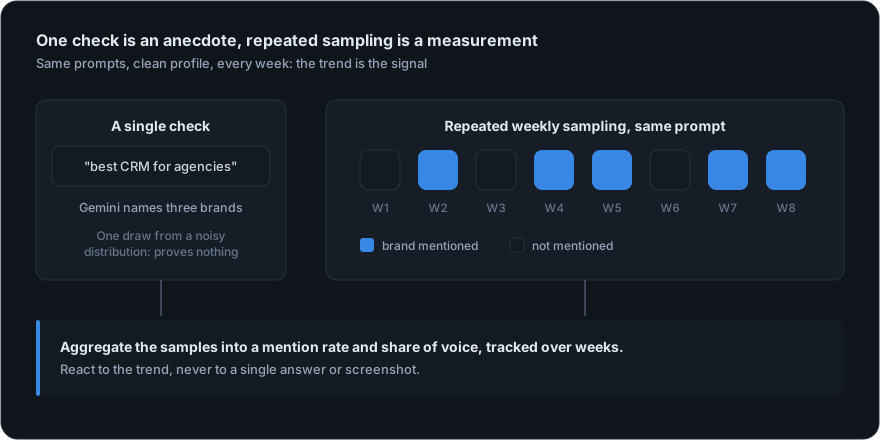
The consequence: a single Gemini check is an anecdote, not a measurement. Meaningful tracking means repeated sampling of the same prompts over time, aggregated into mention rates and trends. Every method below is built on that principle. The same problem applies to tracking ChatGPT mentions, and the same discipline solves it.
How to Track Gemini Mentions Manually (Step by Step)
Manual tracking is free and works today. To make the data worth collecting:
- Build a list of 20-40 real buyer prompts. Recommendation questions ("best X for Y"), comparison questions ("X vs Y for Z"), and problem questions ("how do I..."). Prompts about your brand name tell you little; the money is in prompts where Gemini chooses whom to recommend.
- Neutralize personalization. Use a clean Google profile that has no history with your brand, or turn off Gemini Apps Activity, and start a fresh chat for every prompt. Otherwise you are measuring what Gemini says to you, not to a buyer.
- Note the model. Record which model tier answered. If your buyers are mostly on the free tier, the free-tier answers matter most.
- Watch for grounding. When Gemini searches Google before answering, it shows sources. Record them: they tell you which pages are driving mentions.
- Repeat weekly. Same prompts, same conditions. The trend in your mention rate is the signal; individual answers are noise.
Cost: about an hour a week for 30 prompts. Honest assessment: this works as a baseline and decays the first week someone gets busy. And because weekly sampling of a noisy distribution converges slowly, expect a month or two before you can distinguish real movement from variance.
What to Record
For each prompt, log five things in a spreadsheet:
- Mentioned: yes or no
- Position: first recommendation, second, third, or later
- Framing: recommended, listed neutrally, or mentioned with caveats
- Competitors named: every brand in the answer, not just yours
- Sources shown: the pages Gemini surfaced when it grounded the answer
From this you can compute the two numbers that matter: your mention rate (share of prompts where you appear) and your share of voice (your mentions versus each competitor's on identical prompts). Track both over time.
Four Mistakes That Ruin Gemini Tracking
- Testing from your own account. You search for your brand daily, your history says so, and a personalized Gemini will happily reflect that back at you. Data collected from a signed-in work profile flatters you and measures nothing.
- Treating one answer as the truth. One great answer is not a win and one bad answer is not a crisis. Both are single draws from a noisy distribution. React to your mention rate over weeks, not to screenshots.
- Ignoring the sources. When Gemini grounds an answer in Google Search, the pages it surfaces are the mechanism behind the mention. Track mentions without tracking sources and you can see problems but never fix them.
- Tracking Gemini in isolation. Your buyers are spread across ChatGPT, Google Search's AI surfaces, Perplexity and Gemini, and each engine selects brands differently. A Gemini-only view, like a ChatGPT-only view, regularly misleads.
Which Tools Can Track Gemini Mentions? (Including Ours)
Several AI visibility tools list Gemini among their tracked engines. If Gemini answer tracking is a hard requirement, verify what a vendor actually samples before buying: the consumer Gemini app with grounding, or an API call that behaves differently from what buyers see. The gap between those two is the difference between measuring the product and measuring a proxy of it.
And here is where we owe you directness: Geonimo does not track Gemini answers today. Gemini answer tracking, along with Google AI Overviews, is on our roadmap. What Geonimo tracks daily is ChatGPT, Google AI Mode and Perplexity. We would rather tell you that plainly than sell you a dashboard with a Gemini logo on it.
Two things are worth knowing about that trade-off.
Google AI Mode is often the better measurement target anyway. If your underlying question is "how does Google's AI treat my brand", Google AI Mode is Google's fullest AI answer surface: the full AI experience inside Google Search itself, built on Gemini models and grounded in Google's index, sitting exactly where buying research happens. Tracking it daily, as Geonimo's Google AI Mode visibility tracker does, usually answers the Google question more directly than sampling the standalone Gemini app. The same prompts run in parallel on ChatGPT and Perplexity through multi-model monitoring, so you can tell a Google-specific gap from a category-wide one.
Gemini traffic is already visible. Geonimo's AI Tracker, the site analytics side of the platform, detects visits arriving from gemini.google.com along with crawls from Google-Extended, Google's AI training crawler. So while per-answer Gemini tracking is not live yet, Gemini-driven traffic to your site and Google's AI crawling of it are measurable today.
If you need per-answer Gemini data right now, the manual method above is the free option, and a tool that genuinely samples the consumer Gemini surface is the paid one. When our Gemini answer tracking ships, it will be because we can do it at the same standard as the other three engines, with verified sources and repeated daily sampling, not before.
Start This Week
Write down the 10 questions you most want Gemini to answer with your brand. Ask them today, in fresh chats, from a clean profile, and record who gets named and which sources appear. That 30-minute exercise gives you a real baseline and usually makes AI visibility concrete in a way no article can.
Then decide how much of the ongoing sampling you want to own manually. For the automated version across ChatGPT, Google AI Mode and Perplexity, with verified citations and competitor share included, get a free audit: first insights on your brand within 24 hours.
Related Articles