To track brand mentions in ChatGPT, run a fixed set of buyer prompts against it on a schedule, record whether and how your brand appears, and aggregate the results into a mention rate you can trend over time. There are three ways to do it: manual sampling (free), DIY API scripts, or an automated tracking platform. This guide covers all three, plus the metrics to record and the mistakes that ruin the data.
Why bother at all? Somewhere in the past hour, a buyer in your category asked ChatGPT what to use, and ChatGPT named three brands. Nothing about that conversation appears in your analytics. If you were one of the three, you may get a signup you'll attribute to "direct". If you weren't, you'll never know the deal existed. Tracking brand mentions in ChatGPT is how you make that invisible funnel visible.
First, Understand the Measurement Problem
ChatGPT is non-deterministic: the same prompt asked twice can return different brands, in different orders, with different framing. It also behaves differently with web search on versus off, across models, and after every OpenAI update.
That means a single check is an anecdote, not a measurement. If you ask "best CRM for consultants" once and see your brand, you know one sample of a distribution. Real tracking is repeated sampling: the same prompts, asked regularly, with results aggregated into rates and trends. Keep that in mind as you pick a method: the question isn't "can I check?", it's "can I sample consistently?"
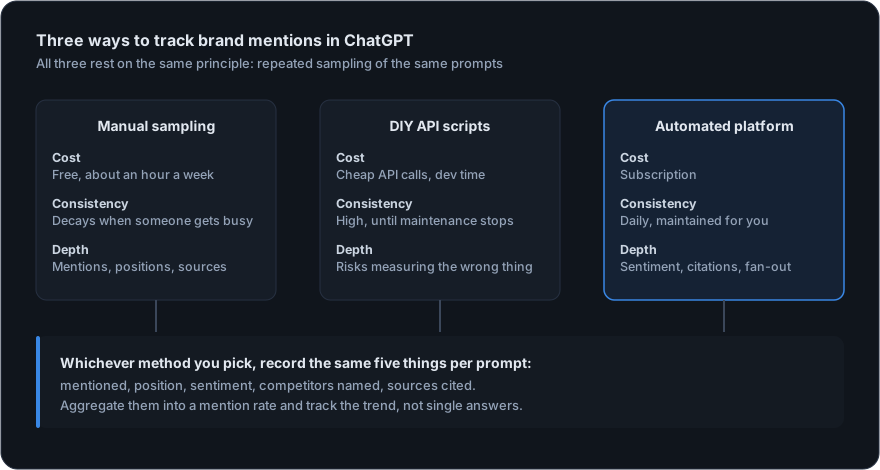
Method 1: Manual Sampling (Free)
Build a prompt list and work through it in ChatGPT on a schedule. To make manual checking as meaningful as possible:
- Use 20-40 real buyer prompts: recommendation questions ("best X for Y"), comparison questions ("X vs Y for Z"), and problem questions ("how do I..."). Not just your brand name.
- Use a fresh session per prompt and turn off memory/custom instructions: otherwise earlier conversation contaminates the answers.
- Record five things per prompt: mentioned yes/no, position (1st/2nd/3rd recommendation), sentiment/framing, competitors named, and sources cited when web search fires.
- Repeat weekly, same prompts, and track the mention rate over time, not individual answers.
Cost: about an hour per week for 30 prompts. Honest assessment: this works as a first baseline and stops working the week someone gets busy. And weekly sampling of a noisy distribution means you'll need a month or two to distinguish real movement from variance.
Method 2: DIY API Scripts
Technical teams sometimes script it: call the OpenAI API with each prompt daily, store responses, and grep for brand names. This gets you consistency and history at API cost (cheap for 30-50 prompts).
The gotchas that bite most DIY setups:
- The API isn't the product. ChatGPT's consumer answers include web search behavior, and the plain API without search tools behaves differently. Track the search-enabled model configuration or your data measures the wrong thing.
- Mention extraction is harder than string matching. Brands appear with typos, abbreviations, in comparisons, or with a domain instead of a name. Competitor detection needs an entity list and fuzzy matching, or the data undercounts everyone.
- Someone must maintain it through model deprecations, response format changes, and the analysis layer everyone forgets to build (positions, sentiment, trends, competitor share).
Method 3: Automated Tracking Platforms
Purpose-built trackers run your prompt set against ChatGPT daily and handle the extraction and analysis layers: mention detection against your tracked brand and competitors, position and sentiment scoring, citation capture, and trend charts.
Geonimo's ChatGPT Visibility Tracker adds two layers most tools skip. First, when ChatGPT searches the web before answering, Geonimo captures the fan-out queries it ran and every source it cited or silently read, which is usually where the "why am I not mentioned?" answer lives. Second, the same prompts run in parallel on Google AI Mode and Perplexity, so you can tell a ChatGPT-specific gap from a category-wide one.
New prompts are analyzed within minutes, so you can test hypotheses ("do we show up for agency-specific prompts?") without waiting a cycle.
The Metrics That Matter
- Mention rate (visibility score): % of tracked prompts where ChatGPT names you, aggregated daily. Your single baseline number.
- Share of voice: your mentions vs each competitor's on identical prompts. The honest competitive KPI: your score can rise while your share falls.
- Position. First recommendation converts very differently than 'also worth considering'. Track ordinal position, not just presence.
- Sentiment & framing: 'The industry standard' and 'a budget option with mixed reviews' are both mentions. Only one wins deals.
- Citations: the URLs ChatGPT reads and cites for your prompts. Your placement target list, and the leading indicator of future mentions.
For the visibility score formula and what a good score looks like by category position, see our AI visibility score guide.
Four Mistakes to Avoid
- Tracking only your brand name. "What is [Brand]?" tells you almost nothing. The money is in category and problem prompts where ChatGPT chooses whom to recommend.
- Panicking over single answers. One bad answer is variance. A week of declining mention rate is a trend. React to trends.
- Ignoring the sources. Mentions are the output; citations are the mechanism. If you track mentions without tracking which sources drive them, you can see problems but not fix them.
- Tracking ChatGPT alone. Your buyers also ask Google AI Mode, Perplexity and Gemini, and each engine selects brands differently. Single-engine data regularly misleads. (Gemini needs its own approach: see how to track brand mentions in Gemini.)
Pair Mention Tracking With Referral and Crawl Data
Mention tracking tells you what ChatGPT says about you. Two other data streams complete the picture:
- ChatGPT referral traffic. Visits from chatgpt.com show up in analytics only if you separate them from generic referrals. They are the downstream proof that mentions turn into clicks and conversions.
- Crawler activity. Before ChatGPT cites a page, its crawlers fetch it. Watching ChatGPT-User and OAI-SearchBot hit (or ignore) your site is a leading indicator of citation trends; we covered a real episode of this in why ChatGPT citations drop after model updates.
Geonimo's AI Tracker captures both server-side, so AI referrals and bot crawls appear alongside your mention data instead of in a separate logs project. And if the crawl data shows OpenAI's bots never visit at all, check your robots.txt with the free AI crawlability checker: a leftover block erases you from answers regardless of how good your content is.
Start This Week
Write down the 10 questions you most want ChatGPT to answer with your brand. Ask them today in fresh sessions and record who gets named. That 30-minute exercise is your baseline, and usually the moment AI visibility stops being abstract.
For the daily, automated version with citations and competitor share included, get a free audit: first insights on your brand within 24 hours.
Related Articles