Quick answer: the best AI SEO tool depends on which of two jobs you mean. For visibility in AI answers, the job classic tools cannot do, Geonimo is the pick: daily tracking on ChatGPT, Google AI Mode and Perplexity plus a team that ships the fixes, from $199/mo with a free audit first. For using AI to do classic SEO faster, Surfer leads content optimization and Semrush leads the suites. The full breakdown, by job, follows.
"AI SEO tools" has become the most overloaded phrase in marketing software. It means two genuinely different things: tools that use AI to do SEO work faster, and tools that optimize your visibility in AI, inside ChatGPT, Google AI Mode and Perplexity answers. Most listicles blur them together, and buying decisions go wrong exactly there.
So this list is organized by job. Twelve tools, four jobs, honest picks, including where our own product does and doesn't belong. (Disclosure: we build Geonimo, entry number one.)
Tools That Use AI vs Tools for AI Visibility
The split matters because the two families answer different questions. Tools that use AI (Surfer, Clearscope, Frase, the AI features inside Semrush and Ahrefs) make existing SEO work faster: research, briefs, drafts, audits. Tools for AI visibility (Geonimo, Profound, Peec AI, Otterly) answer a question classic SEO never had to ask: when ChatGPT or Google AI Mode recommends products like yours, are you in the answer, and which sources put you there?
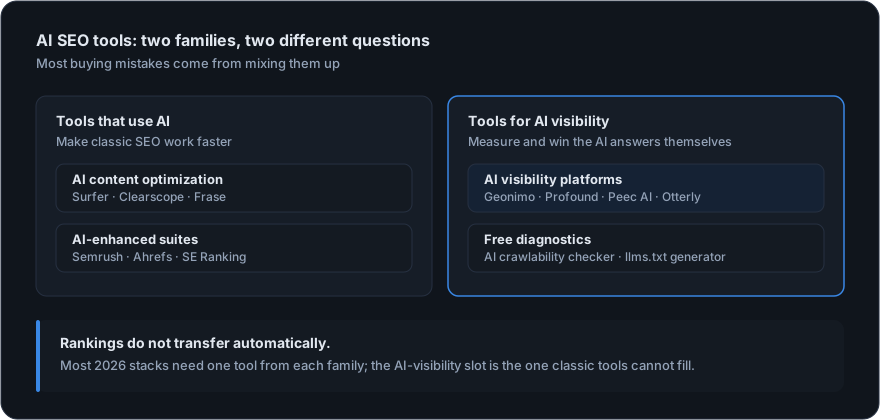
Your classic rankings do not transfer automatically. Our citation research keeps finding pages that rank well in Google while being absent from AI answers on the same intent, usually because the page never states the direct answer an engine wants to quote. That is why the jobs below are separated, and why most 2026 stacks need one tool from each family.
The 12 Best AI SEO Tools at a Glance
| Tool | Job | Best for | Starting price |
|---|---|---|---|
| Geonimo | AI search visibility | Tracking plus done-for-you execution | $199/mo ($159/mo billed yearly) |
| Profound | AI search visibility | Enterprises with dedicated AEO teams | Custom (reported from $99/mo) |
| Peec AI | AI search visibility | Self-serve teams and agencies | $95/mo (€89) |
| Otterly.AI | AI search visibility | Budget monitoring | $29/mo |
| Surfer SEO | AI content optimization | On-page scoring and AI-assisted drafting | Vendor plans |
| Clearscope | AI content optimization | Editorial teams with quality bars | Vendor plans |
| Frase | AI content optimization | Brief-to-draft workflows on a budget | Vendor plans |
| Semrush | AI-enhanced suite | Full-stack SEO plus the AI Toolkit add-on | Vendor plans |
| Ahrefs | AI-enhanced suite | Index-scale data plus Brand Radar | Within Ahrefs plans |
| SE Ranking | AI-enhanced suite | Value suite with AI visibility toolkit | Vendor plans |
| AI Crawlability Checker | Technical diagnostic | Everyone | Free |
| llms.txt Generator | Technical diagnostic | Everyone | Free |
Job 1: AI Search Visibility (Being in AI Answers)
1. Geonimo: visibility tracking + execution
Geonimo tracks ChatGPT, Google AI Mode and Perplexity daily at the consumer surface, using unbranded prompts (how buyers ask before they know brand names) with share of voice reported at 95% confidence intervals. Citations are verified, meaning they only count when the cited page actually names you, and the AI Tracker ties it all to outcomes: AI bot crawls, AI referrals and conversions on your site. The part no dashboard replicates is the execution team that ships the content, schema and entity fixes the data calls for. From $199/mo ($159/mo billed yearly), $399/mo for the Expansion tier, with a free audit before signup and no trial. Yes, this is us; the free audit lets you judge the data yourself.
2. Profound: enterprise answer-engine insights
The enterprise reference, with a reported $1B valuation and the broadest tracked-engine set in the category, including surfaces like Copilot. Prompt volumes (query demand data), agent analytics (how AI agents traverse your site) and shopping insights go deeper than anything else on the market, and pricing matches: demo-gated and custom, with reported figures from a $99/mo entry tier up to $2,000 to $5,000+ per month for enterprise contracts. Right when you have a dedicated AEO team to absorb the data. Head-to-head: Geonimo vs Profound.
3. Peec AI: self-serve visibility dashboard
The strongest pure self-serve dashboard: polished interface, unlimited seats on every plan, an MCP server for pulling data into AI assistants, and dedicated agency plans. Transparent pricing runs from €89 ($95) at Starter to €425 ($495) at Advanced, with prompt caps per tier. Extra engines beyond the base plan are paid add-ons, and there is no execution layer: you do the optimization work. Best for mid-market teams and agencies with hands to spare. Full breakdown: Geonimo vs Peec.
4. Otterly.AI: lightweight monitoring
The best budget entry at $29/mo: AI answer monitoring across ChatGPT, Perplexity and Google AI Overviews, with some of the strongest AI Overviews educational content in the category, also available as a Semrush App. Lightweight by design; you outgrow it when you need daily competitive depth and citations.
Worth knowing in this job too: Writesonic (around $199/mo) pairs AI visibility tracking with a content Action Center, an interesting fit if you want tracking and content production from one vendor.
Choosing within this job comes down to who does the work afterward. Pick Otterly if you just need an early-warning signal, Peec AI if you have hands to act on the data yourself, Geonimo if you don't and want the fixes shipped for you, and Profound if you run a dedicated AEO team at enterprise scale. Full landscape for this job: 10 Best AI Visibility Tools and our comparison hub.
Job 2: AI Content Optimization
5. Surfer SEO
The standard for on-page content scoring and AI-assisted drafting against live SERP data. The editor workflow is the draw: writers see term coverage, structure and length targets update in real time, and the content score gives in-house teams and freelancers a shared, objective target to write toward. Best for content teams publishing at volume who want a repeatable optimization process rather than editor intuition alone.
6. Clearscope
The premium option with a quality-first reputation. Clearscope's content grading and deliberately clean editor made it the favorite of editorial teams that care about reader experience as much as rankings, and its shareable reports are easy to hand to freelance writers without training them on a tool. It optimizes for depth and relevance rather than keyword stuffing, which also happens to produce the direct, well-structured writing AI engines prefer to cite. Best when content quality is a brand issue, not just a traffic issue.
7. Frase
The value pick: research-to-brief-to-draft in one flow, at pricing accessible to small teams. Frase compresses the SERP research and outline stage dramatically, pulling competitor headings and the questions people actually ask into a working brief in minutes, which is where most content operations lose their hours. The drafting is serviceable rather than best-in-class, but the brief quality is what you are buying. Best for lean teams and agencies that need consistent briefs and first drafts fast.
One caveat from our citation research: content optimized only for classic SERPs often underperforms in AI answers. AI engines cite pages that answer questions directly with clear structure, so pair any content tool with an AEO checklist.
Job 3: AI-Enhanced SEO Suites
The suites spent the last two years adding AI on both sides: assistants that speed up classic SEO work, and monitoring modules that watch AI answers. Neither replaces a dedicated visibility platform yet, but if you already pay for a suite, these features are the cheapest place to start.
8. Semrush (AI features + AI Toolkit)
The full-stack suite with AI assistance across research, audits and content, plus the AI Toolkit add-on for AI visibility monitoring. The Toolkit took the top spot on G2's Spring 2026 AEO grid, and for teams already on Semrush it is the fastest way to get directional AI answer data next to classic rankings. Directional is the operative word: daily answer sampling, verified citations and attribution still live in dedicated platforms.
9. Ahrefs (AI features + Brand Radar)
Index-scale data with AI-assisted workflows, plus Brand Radar for AI mention analytics drawn from Ahrefs' own index. Brand Radar is excellent for market-level trends and competitive share over time; it lives within Ahrefs plans (check current packaging for what your tier includes), and index-based analysis suits market reporting more than daily sampling of your own prompt set. Head-to-head: Geonimo vs Ahrefs Brand Radar.
10. SE Ranking
The value suite: classic SEO plus an AI visibility toolkit at accessible pricing, one login. You get directional AI tracking (mentions, visibility trends) next to rank tracking and site audits, at a total cost well below running a suite and a dedicated platform side by side. Best for small teams consolidating tools; teams accountable specifically for AI search performance will want a dedicated platform on top.
Job 4: Technical & Diagnostic (Free)
11. AI Crawlability Checker (free)
Checks whether GPTBot, OAI-SearchBot, ClaudeBot, PerplexityBot and Google-Extended can access your site. It is the 10-second test that catches the most damaging silent failure in AI SEO: a robots.txt or firewall rule quietly blocking the crawlers that feed AI answers.
12. llms.txt Generator (free)
Generates the AI-readable content map for your site in a minute, giving AI systems a clean index of your most important pages. Run it after the crawlability check: access first, then the map.
The 2026 Stack, Practically
A working setup for most teams: one suite (job 3) for classic SEO, one content tool (job 2) if you publish at volume, the free diagnostics (job 4) run once, and a dedicated AI visibility platform (job 1) the moment AI search becomes a channel you're accountable for. That last slot is the one classic tools genuinely can't fill yet: daily answer sampling, verified citation capture and Google AI Mode coverage live only in the dedicated platforms.
By team shape, that resolves differently. A solo marketer or small business runs the free diagnostics, adds Otterly or a low-cost tracker for monitoring, and upgrades only when AI referrals start showing in analytics. An agency keeps the suite it already owns, adds Peec AI or Geonimo for client-facing AI visibility reporting, and standardizes one content tool for production. An in-house team accountable for pipeline pairs its suite with Geonimo (measurement plus execution) or Profound (enterprise scale, with a team to run it) and treats everything else as optional.
The cheapest way to find out if you need job 1 at all: a free AI visibility audit. Your brand across ChatGPT, Google AI Mode and Perplexity, first insights within 24 hours, no card and no trial to cancel. If the answers already recommend you everywhere, congratulations; if they don't, now you know the gap.
Related Articles