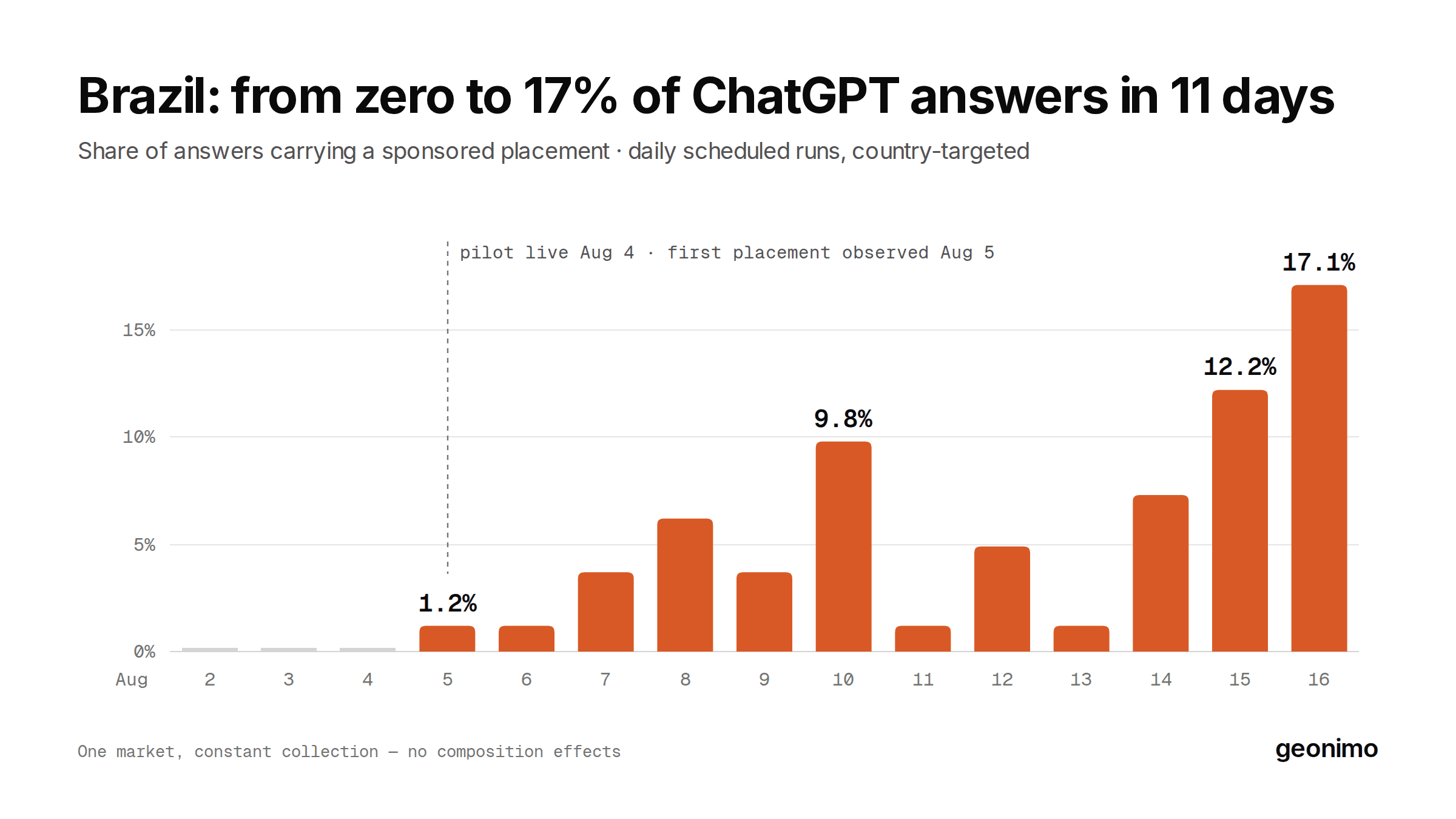
On August 4, not a single ChatGPT answer we track in Brazil carried an ad. On August 5, the first sponsored placement appeared. Eleven days later, ads were showing on 17% of answers.
That is the fastest ad ramp we have measured in any market, and it says a lot about where AI search is heading everywhere else.
TL;DR: What two weeks of daily tracking shows
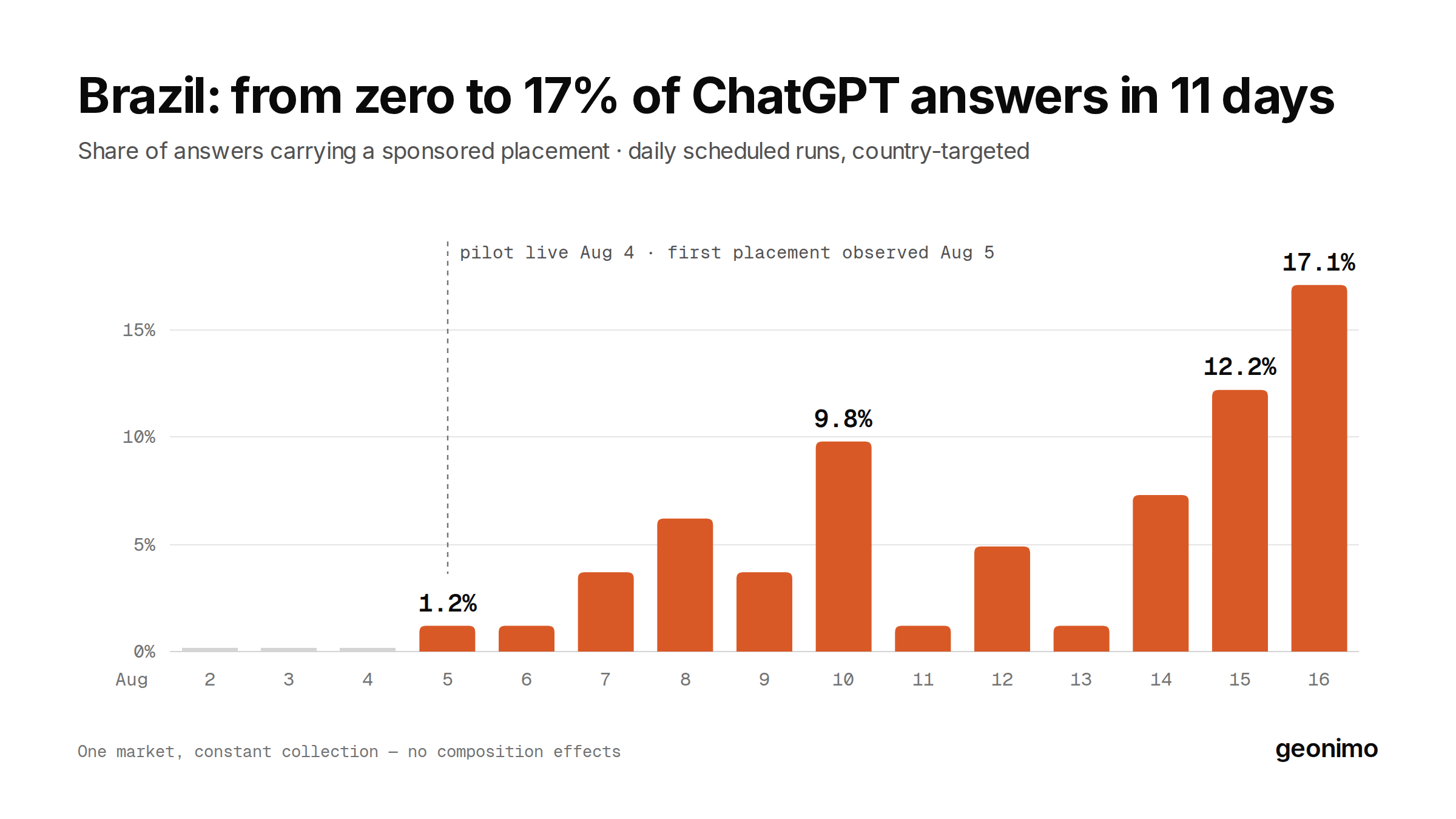
- The first ad in a Brazilian ChatGPT answer appeared on August 5. By August 16, 17.1% of the answers we track carried at least one.
- Brazil is one of nine countries in OpenAI's ad pilot, and among the newest. The pilot spans the US, Canada, Australia, New Zealand, the UK, Mexico, Japan, South Korea and Brazil; the EU is not part of it yet.
- Brazil already edged past the US. Over the last week, 7.7% of Brazilian answers carried an ad, versus 6.6% in the US and 3.6% in the UK.
- Ad density is rising, not just reach. The average ad-carrying answer went from 1.3 to 1.6 ads week-over-week, and we have seen up to 10 ads in a single answer.
- The auction is wide open. 207 distinct advertisers in two weeks, and 3 out of 4 of last week's advertisers were buying for the first time.
- This is a ChatGPT story, for now. Across the same prompts and the same window, Google AI Mode and Perplexity served zero ads.
How we measured this
We run the same brand and purchase prompts through ChatGPT every day, geo-targeted at country level, and extract every native sponsored placement from the answer payload: the actual ad units ChatGPT renders beside and inside its answers, not organic product mentions. It is the paid twin of the daily loop we use for tracking brand mentions in ChatGPT.
The timing checks out externally, too: press coverage places OpenAI's Brazilian switch-on at August 4 (gHacks, Unite.AI). Our first observed placement landed on August 5, the next daily run after the flip. The announcements tell you when the switch turned on; the chart below shows what the auction did next, measured from day one.
The chart below is one market, with constant collection throughout the window. That matters: blended, multi-market averages move when the mix of tracked markets changes. A single market with an unchanged daily schedule cannot be distorted that way. What you see is the rollout itself.
Two things to read in the shape:
- The ramp is noisy by day. August 10 hit 9.8%, August 11 fell back to 1.2%. These are live auctions, not scheduled campaigns. Day-level swings are normal, and single-day numbers should never be quoted alone.
- The trend is not noisy. Zero for the first three days, low single digits in week one, double digits by the end of week two. Each successive peak is higher: 1.2%, then 6.2%, then 9.8%, then 17.1%.
Where ChatGPT ads run today
OpenAI's ad pilot officially covers nine countries: the US, Canada, Australia, New Zealand, the UK, Mexico, Japan, South Korea and Brazil. We measure three of them daily, and all three now serve ads:
| Market | Answers with ads (Aug 10-16) |
|---|---|
| Brazil | 7.7% |
| United States | 6.6% |
| United Kingdom | 3.6% |
Key finding: Brazil is the newest of the three markets we measure, and it already shows the highest ad rate. Where the pilot is switched on, the auction fills in fast: the gap between "no ads" and "leading market" was eleven days.
What the ads actually look like
The volume ramp is only half the story. Inside the ad-carrying answers, three patterns stand out:
Density is climbing. Week-over-week, total ads grew 58%, and the average ad-carrying answer went from 1.3 to 1.6 ads. The current record in our corpus is 10 ads in a single answer. Brazil is earlier on that curve, with most of its ad answers still carrying a single placement, but the US shows where it goes.
The buyers change every week. Two weeks of tracking surfaced 207 distinct advertisers, and 3 out of 4 of last week's advertisers had never appeared before. This is not a settled auction with incumbent budgets; it is advertisers testing a brand-new channel, week by week.
Targeting is still early. We watched a laboratory-chemicals supplier run an ad, in English, on a Portuguese home-improvement question. We also see the opposite pattern maturing fast: in Brazil, the top advertiser of the last week was a building-materials supplier showing up on building-materials prompts. Relevance is arriving; it just isn't evenly distributed yet.
And one pattern brands should sit with: the slots are mostly going to retailers and challengers, not to the brands being asked about. On sneaker prompts, ads featuring major sportswear products are bought by shoe retailers, while the brands themselves aren't bidding. The paid slot above your organic mention is for sale, and right now, someone else is likelier to buy it than you are. If you already watch your share of voice in AI answers, this is the paid layer moving in on the same real estate.
The SERP playbook, replaying in the answer layer
If this sequence feels familiar, it should. Search engines followed the same arc twenty-five years ago: organic answers first, then a few ads in a few markets, then rising density, then a mature auction where the paid slot above your name is contested inventory and defending it is a line item.
The answer layer is at step two of that arc, and it is moving in weeks, not years. Geography decides when it reaches your customers: if they are in the US, the UK or Brazil, it already has.
The practical takeaway is the same one we give for organic AI visibility: you can't manage what you don't measure. Knowing which of your prompts carry ads, whose ads they are, and what sits above your brand's organic mention is now part of knowing how AI answers present you. Geonimo's ChatGPT Visibility Tracker records both sides of that picture on every tracked prompt: your organic mentions and citations, and the sponsored placements now appearing beside them.
Want to know what the auction already looks like around your brand in the US, the UK or Brazil? Get your free audit and see it prompt by prompt.
ChatGPT ads: quick answers
Does ChatGPT have ads now?
Yes. OpenAI has been piloting sponsored placements since early 2026, and as of mid-August the pilot officially covers nine countries. Ads are shown to logged-in adult users on the Free and Go tiers; Plus, Pro and Enterprise plans stay ad-free. In our tracked markets, ads currently appear in the US, the UK and Brazil.
What do ChatGPT ads look like?
They are native sponsored placements rendered with the answer: an advertiser name, creative copy and a link, visually separated from the organic response and labeled as sponsored. They are contextually matched to the conversation, with mixed precision so far: some placements are squarely on-topic, others miss by a wide margin.
How many ads does ChatGPT show per answer?
Usually one, but density is rising. In our corpus the average ad-carrying answer went from 1.3 to 1.6 ads in a single week, and we have observed up to 10 sponsored placements in one answer.
Which countries have ChatGPT ads?
OpenAI's pilot currently covers nine countries: the US, Canada, Australia, New Zealand, the UK, Mexico, Japan, South Korea and Brazil. The EU is not part of the pilot yet.
Method: Geonimo measurement corpus, August 2-16, 2026. Identical prompt sets run daily against ChatGPT, Google AI Mode and Perplexity with country-level geo-targeting; an "ad" is a native sponsored placement extracted from the answer payload, on the free-tier surface where OpenAI currently serves ads. The Brazil chart covers a single market with unchanged daily collection across the whole window, so its trend carries no market-mix effects. Published ad-rate estimates vary widely between trackers because their prompt mixes differ; we hold the prompt set constant, which is what makes day-to-day and week-over-week comparison meaningful. Day-level figures swing with the auction; quote weekly rates, not single days.
Related Articles