ChatGPT SEO is the practice of optimizing your brand's web footprint so that ChatGPT names and cites you when it answers your buyers' questions. ChatGPT now answers hundreds of millions of buying questions a week. Each answer names a handful of brands, and the selection is not random: it follows patterns you can measure and influence.
The name is slightly misleading (there are no rankings to climb and no index to submit to) but the discipline is real. Here is how ChatGPT actually selects brands and sources, and the five-step playbook to become one of them.
How ChatGPT Selects Brands and Sources
The scale is worth stating first: OpenAI reports more than 900 million weekly ChatGPT users. And these users ask differently than searchers: Semrush's analysis of 80M+ clickstream records found prompts averaged 23 words without search enabled versus 4.2 words with it. Long, conversational, intent-rich questions are the norm, which is exactly why keyword-era optimization misses the target.
Every ChatGPT answer draws on two systems:
- The model's prior: what it learned in training from listicles, reviews, forums, docs and news. This decides which brands "come to mind" for your category and how they're framed.
- Web search: for commercial and current prompts, ChatGPT searches before answering, decomposing the question into several hidden queries (query fan-out) and reading the results. Those retrieved sources heavily shape who gets named and cited.
Neither system reads your meta keywords. Both aggregate what the web says about you, which makes ChatGPT SEO closer to reputation engineering than to classic on-page work. Our analysis of 2.1M sources cited by AI engines confirms how wide that aggregation runs: 73.5% of citations come from domains outside the top 100 most cited, and Reddit is the single most-cited domain in the dataset.
The 5-Step ChatGPT SEO Playbook
Step 1: Open the door
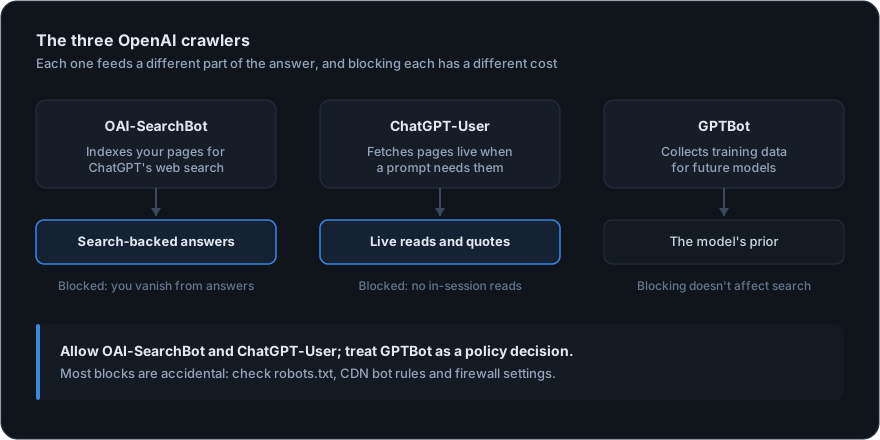
Before anything else, make sure OpenAI's crawlers can read your site. Three bots matter, and they do different jobs:
| Bot | What it does | If you block it |
|---|---|---|
| OAI-SearchBot | Indexes pages for ChatGPT's web search | You disappear from search-backed answers |
| ChatGPT-User | Fetches pages live when a user's prompt needs them | ChatGPT can't read or quote your pages in-session |
| GPTBot | Collects training data | Your policy call; blocking it doesn't affect search answers |
A healthy robots.txt for ChatGPT visibility looks like this:
User-agent: OAI-SearchBot
Allow: /

User-agent: ChatGPT-User
Allow: /
The failure mode is almost always accidental: a legacy Disallow: / left over from a staging launch, a blanket bot rule in a CDN firewall, or a robots.txt that allowlists Googlebot and blocks everything else. Any of these can erase you from answers while your Google rankings look perfectly healthy. Check yours in 10 seconds with the free AI crawlability checker.
Step 2: Baseline your visibility
You cannot improve what you have not measured, and ChatGPT is non-deterministic, so measurement means repeated sampling, not a one-off check. Build a prompt set of 30 to 50 questions your buyers actually ask, mixing intent levels:
- "best [category] for [segment]" (the classic shortlist prompt)
- "[competitor] alternatives"
- "[your brand] vs [competitor]"
- "how do I solve [the problem you solve]?"
- "[category] pricing comparison"
Run them daily and record four things per prompt: whether you are mentioned, your position in the answer, the sentiment of the mention, and (critically) which sources ChatGPT cites when answering. That last column is the input for step 3. (The full manual and automated setup is in our guide to tracking brand mentions in ChatGPT.)
Step 3: Win the retrieved sources
The citation data from your baseline gives you the exact listicles, review platforms and articles ChatGPT reads for your category. This is the highest-leverage work in the playbook, because those pages are the ballot box: when ChatGPT builds a shortlist, it largely aggregates the shortlists it retrieved.
In practice the source list for a B2B category looks something like: two or three "best X in 2026" listicles, a G2 or Capterra category page, one comparison article, and a Reddit thread. The work is unglamorous and concrete:
- Pitch the listicle authors. They refresh quarterly and want current tools; a short, factual email with your differentiator and pricing often gets you added.
- Fill out your review-platform profiles and generate a steady drip of genuine reviews.
- Answer the Reddit threads honestly, as yourself. Founder-voice replies age well and keep getting retrieved for years.
Prioritize by two dimensions: how often a source appears in your citation data, and how winnable it is. A listicle that shows up for a third of your tracked prompts and accepts submissions beats a prestigious publication that cited your category once. Work the list top-down and re-pull the data monthly, because the retrieved set shifts as the web does.
Getting into the retrieved sources moves answers within weeks, because it changes what the model reads rather than waiting for what it remembers.
Step 4: Publish answer-shaped content
ChatGPT cites passages that map cleanly to what was asked. That has two implications: cover the questions it actually searches, and write so a passage can be lifted whole.
Cover the fan-out. When a buyer asks "best CRM for startups", ChatGPT may never search that phrase. It runs its own queries, something like:
- best CRM for startups 2026 reviews
- CRM pricing comparison small business
- hubspot vs pipedrive vs salesforce
- best CRM free trial for startups
Each sub-query is a retrieval you can win or lose. Publish one page per recurring sub-query rather than one mega-page targeting the visible prompt.
Write citable passages. A citable passage answers the question completely in two or three sentences, with the specifics included, and would make sense pasted into a chat on its own. Compare:
Not citable: "Pricing shouldn't be a barrier to growth. That's why we offer flexible plans designed to scale with your business. Contact us to learn more."
Citable: "Geonimo costs $199 per month, or $159 per month billed yearly. Every plan starts with a free audit; there is no free trial."
The second version names the entity, states the numbers, and survives extraction. Apply the same shape to your feature pages, comparison pages and FAQ answers: direct answer up top, question-form headings, FAQ schema underneath.
Step 5: Fix your entity
Models hedge on brands they cannot pin down. If your positioning reads differently across your site, LinkedIn, directories and old press coverage, ChatGPT is likelier to skip you or bury you mid-list. Run this checklist:
- One canonical description. A single one-sentence answer to "what is [brand]?", used verbatim on your homepage, About page, LinkedIn, and directory profiles.
- One category label. Pick it ("AI visibility platform") and stop alternating between five variants.
- Organization and Product schema on your site stating name, logo, description and offers machine-readably.
- Consistent facts everywhere. Founding year, HQ, pricing and feature claims should match across every profile; stale third-party pages are how wrong answers get written.
- Disambiguate collisions. If your name is shared with another company, make your category label do the separating work in every description.
What a canonical description looks like in practice: "Geonimo is an AI visibility platform that tracks how ChatGPT, Google AI Mode, and Perplexity mention and cite your brand." One sentence, category label included, no adjectives a model would discard. When that exact sentence appears on your homepage, LinkedIn, and every directory, ChatGPT stops guessing what you are.
How to Be Named First, Not Just Mentioned
Being in the answer is the entry ticket; the first brand named wins something close to a default, because users rarely interrogate recommendation number three. Position is a probability you shift with the same levers as mention rate, plus two that matter disproportionately at the top of the list:
Win the community layer. Reddit and community threads are heavily present in both training data and retrieval for "best X" questions. A category where every "what should I use?" thread names your competitor is a category where ChatGPT names them first. This cannot be astroturfed; it compounds from founders answering questions honestly, customers who volunteer your name, and being the tool people actually recommend to each other. Slow, real, and one of the strongest signals in the stack.
Keep freshness and momentum. Retrieval favors current content: 2026-dated listicles, recent reviews, active changelogs. A brand whose third-party coverage is three years old gradually fades down the list even if nothing else changed. Sustained PR, review velocity and content cadence keep you in the retrieval set. In our tracking, the brands named first tend to be the ones present across most of the sources the answer was built from.
The 90-day position playbook:
- Baseline. Track 30 to 50 buyer prompts daily; record mention rate, position, and the sources behind every answer.
- Source placements. Get into the top five third-party sources ChatGPT retrieves for your money prompts.
- Fan-out content. Publish direct answers to the ten most recurring uncovered sub-queries.
- Entity cleanup. Consistent description, schema and crawler access everywhere.
- Community and reviews. Founder-voice presence in the threads; steady review velocity on G2 and Capterra.
- Iterate on data. Double down on whatever moved position; drop what didn't.
What Doesn't Work
- Keyword stuffing for the model. ChatGPT doesn't rank pages by keyword density; it synthesizes from sources it trusts. Optimizing prose "for the AI" instead of for the question wastes effort.
- Astroturfing communities. Reddit and forums matter enormously as signals, and both platforms and models are increasingly good at discounting fake advocacy. Founder-voice honesty compounds; sockpuppets get discounted.
- One-off checks as measurement. ChatGPT is non-deterministic: the same prompt returns different brands run to run. Decisions made on a single screenshot are decisions made on noise.
Measuring ChatGPT SEO
The KPI set mirrors classic SEO, translated to answers: mention rate (share of tracked prompts naming you, your visibility score), position (first recommendation vs afterthought), share of voice against competitors, citation rate of your pages, and downstream, AI referral traffic from chatgpt.com to your site.
Geonimo's ChatGPT Visibility Tracker automates the full loop: daily sampling, fan-out and citation capture, competitor benchmarks, plus attribution of ChatGPT-referred visits and conversions on your site. The playbook above plus that feedback loop is, in practice, the whole discipline.
How Long ChatGPT SEO Takes
Expect two speeds. Retrieval-side changes move in weeks: once a listicle adds you or an answer-shaped page starts winning a fan-out query, search-backed answers can pick it up on the next crawl. Prior-side changes move in model versions: what ChatGPT "remembers" about your category updates only when the underlying model is retrained, which is why sustained third-party coverage matters more than any single placement.
Plan the program accordingly. Steps 1 and 2 are a first-week job. Steps 3 through 5 are an operating rhythm, not a project, and the compounding starts once the baseline shows which changes actually moved your mention rate.
Start where every good program starts: a baseline. Get your free audit and see exactly how ChatGPT answers your buyers' questions today.
Related Articles