
A marketing engineer is the person on a growth team who builds and runs marketing as an engineered system. Instead of executing channel tactics by hand, they instrument how the brand shows up (in AI answers, search results, and analytics), connect that data into a decision loop, and build the repeatable workflows that turn evidence into content, PR, and technical fixes. In AI SEO specifically, the marketing engineer owns the system that makes AI visibility measurable, repeatable, and governable.
A marketing engineer is not simply a marketer who uses AI tools. And it is not just a developer sitting inside the marketing team. It is a hybrid role defined by ownership of the system rather than mastery of one channel.
The role is emerging now because the old mental model broke. A few years ago, SEO job descriptions made intuitive sense: research keywords, optimize pages, fix technical issues, earn links, track rankings. Improve your site, improve your visibility, measure the result. That model is no longer enough. Today, buyers ask full questions in ChatGPT, compare vendors through AI Overviews, and discover brands through answers assembled from multiple sources across the web. The work is no longer just helping a page rank. It is understanding how an answer gets constructed, which sources shape it, and what your team can influence inside that system.
What a marketing engineer does
The marketing engineer connects prompt tracking to source analysis, source analysis to content decisions, content decisions to execution workflows, and execution workflows to business outcomes. They do not just ask, "Are we visible?" They ask, "Which prompts matter, which sources drive those answers, which pages are gaining or losing citations, which teams need to act, and how do we make that loop run every week without rebuilding it from scratch?"
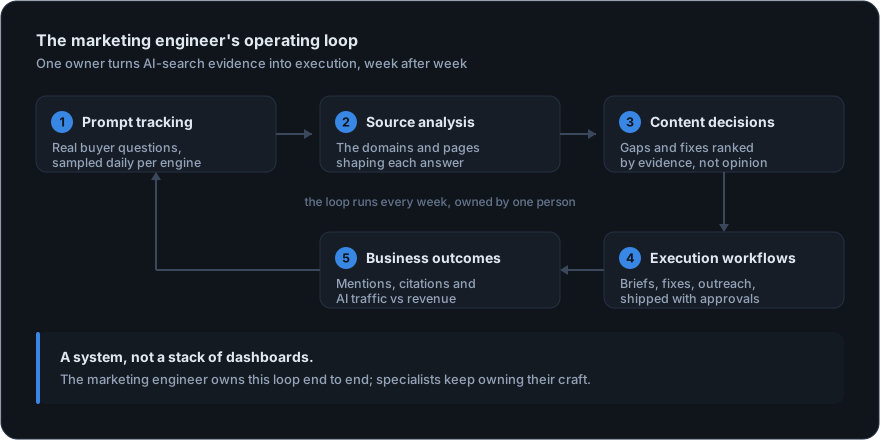
The skill set follows from the loop: SEO fundamentals, working analytics fluency, enough LLM literacy to understand how engines retrieve and cite, light automation or scripting to glue systems together, and the workflow design to keep humans approving what ships.
Marketing engineer vs SEO specialist vs marketing ops
The role is easiest to define against its neighbors. All three are needed; only one owns the visibility system end to end.
| SEO specialist | Marketing ops | Marketing engineer | |
|---|---|---|---|
| Primary surface | Search rankings and organic traffic | The martech stack: CRM, attribution, campaign tooling | Brand visibility across search and AI answers |
| Core question | "How do we rank for this?" | "Do our tools, data, and handoffs work?" | "Which answers matter, what shapes them, and what moves them?" |
| Typical output | Optimized pages, links, technical fixes | Integrations, pipelines, dashboards | An instrumented loop from evidence to shipped fixes |
| Shared ground | Feeds the loop with craft | Feeds the loop with infrastructure | Owns the loop; replaces neither |
Why AI search created the role
This shift is easy to misunderstand because official search guidance still says the fundamentals of SEO remain relevant. That is true. Google has been clear that there are no special technical requirements to appear in AI Overviews or AI Mode, and no special AI-only markup files you need to publish. Helpful content, crawlability, strong page experience, textual clarity, structured data discipline, and reliable information architecture still matter.
But the same guidance also makes something else clear: AI features can rely on query fan-out, multiple supporting searches, and broader sets of supporting pages than classic search results. So while the fundamentals stay the same, the operating model changes. The new job is not finding a gimmick. The new job is building the instrumentation and workflows that let your team see what AI systems are doing and respond with precision.
That is where the engineering part comes in.
Decomposing the work into a system
A marketing engineer starts by decomposing work that most teams still handle manually. Which prompts should we track? Which competitor set matters for each topic? Which domains keep appearing in answers? Which pages on our site are cited without our brand being named? Which answer patterns are improving conversion-quality traffic, not just generating impressions?
Once you break those questions into steps, you begin to see a system instead of a collection of tasks. The pattern is consistent: define the trigger, limit the inputs, collect the right data sources, let the model make a structured judgment, branch based on that judgment, and send the result into a human approval or action flow. That is exactly how modern AI-search teams should operate.
Video: AI Marketing Trends That Will Transform Your Business - HubSpot (HubSpot explores how AI is reshaping marketing) from data analytics and automation to content strategy: based on insights from 1,500+ marketers worldwide.
AI visibility extends beyond your website
The reason this matters so much in AI SEO is that visibility is no longer owned by one team or one page type. AI visibility extends beyond your website. Brands now need to win citations and references across editorial content, reviews, community discussions, product pages, documentation, and other third-party ecosystems that AI systems rely on.
In practical terms, that means the person running AI-search growth cannot stay trapped inside a rank tracker. They need to work across content, product marketing, PR, analytics, and sometimes engineering. The marketing engineer is the operator that makes that cross-functional work tractable.
Treating AI visibility as an optimization problem
There is real upside to doing this well. The 2023 research paper that coined "Generative Engine Optimization" argued that content creators need ways to influence how generative engines surface and summarize their work, and showed that specific optimization methods can boost a site's visibility within generative engine responses by up to 40% on their benchmark.
That does not mean there is a universal AI-search hack. It means that visibility in generative answers is measurable, influenceable, and worth treating as an optimization problem. Once you accept that, the case for a marketing-engineering function becomes much stronger. You do not need more vibes. You need a controlled feedback loop.

Marketing engineers work at the intersection of growth, data engineering, and revenue operations: turning AI search evidence into controlled execution.
A marketing engineer's week, in practice
They build a prompt universe that reflects real buyer questions instead of only keyword clusters. They track how different AI systems represent the brand by topic, region, and engine. They analyze which domains and source types are shaping answers. They compare brand visibility to source visibility to identify where the content is trusted but the brand is still weak.
They connect AI-search reporting to traditional analytics, including AI referral traffic on the site itself, so the team can see whether answer visibility translates into qualified sessions and revenue. And they turn repetitive work into governed workflows: a weekly executive summary, a content-refresh queue, a competitor change alert, a draft brief for a weak topic, or an approval request for a CMS update.
Why teams without an owner struggle
The teams that will struggle most are the ones that stay divided between "SEO people," "content people," and "AI tool experimenters" without anyone owning the system. AI search punishes fragmented workflows.
If nobody owns prompt design, the team tracks the wrong questions. If nobody owns source analysis, the team sees visibility changes but cannot explain them. If nobody owns the execution layer, the reporting becomes another dashboard that people glance at and ignore. If nobody owns governance, the automations become risky and the organization stops trusting them. The marketing engineer solves that by owning the system, not by trying to replace every specialist.
What a marketing engineer is not
It is not a full-time prompt tinkerer surfing for AI hacks. It is not a role purely devoted to generating large volumes of AI-written blog posts. And it is not a replacement for foundational SEO.
If anything, recent AI-search analysis suggests the opposite: teams with weak information architecture, weak entity signals, weak source trust, and weak content clarity will be exposed faster by AI systems, not hidden by them. A marketing engineer does not replace the fundamentals. They make the fundamentals measurable inside a new answer layer.
The future: control planes, not just dashboards
That is why we think the next wave of AI-search tooling will not be defined only by dashboards or only by autonomous agents. It will be defined by control planes: systems that let teams understand AI visibility, expose evidence-backed actions to their preferred AI clients and workflows, and keep approvals, policy, and attribution in one place.
Some teams will call that AI SEO. Some will call it AEO. Some will call it GEO. The label matters less than the operating model. The winners will be the organizations that treat AI search as a systems problem and equip someone to run that system well.
The takeaway
At Geonimo, that is the lens we use. The future of AI-search growth does not belong to teams with the most dashboards. It belongs to teams that can turn AI-search evidence into controlled execution every week. That is what a marketing engineer does. And in the AI-search era, it is becoming one of the most important jobs in modern growth.
If you want to see how your brand performs across ChatGPT, Google AI Mode, and Perplexity, you can book a free audit or explore our pricing.